

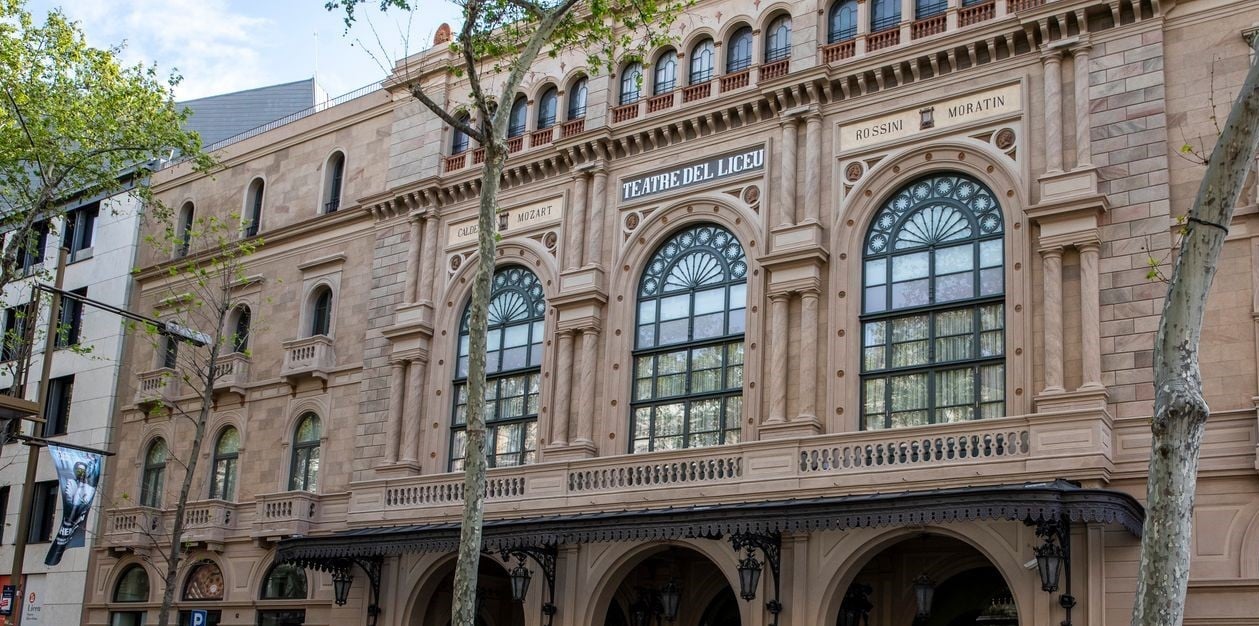
The building
The Gran Teatre del Liceu was erected in the central section of the popular La Rambla in Barcelona, an iconic promenade in Ciutat Vella that has maintained its prominence and vibrant character over time.
It has a built area of 36,000 m², of which 70% is occupied by the stage and service areas, and the remaining 30% corresponds to the areas designated for the public.
Lobby
The main lobby, with access from La Rambla, is one of the spaces that survived the 1994 fire.
The lobby is in an eclectic style based on the Renaissance. This style was known in the mid-19th century as “Florentine” and was a more or less free interpretation of Neoclassicism during the Isabeline era.
The central staircase is made of marble and leads to the first floor where the “Hall of Mirrors” is located. The staircase is also in Neoclassical style. At the top, there is a sculpture of the “Muse of Music,” created by Venanci Vallmitjana. It was installed in 1901.
Auditorium
The faithful reconstruction of the Hall and stage, which were completely destroyed by fire, has allowed for several changes and improvements.
The hall, explicitly inspired by Milan’s Teatro alla Scala, has a horseshoe shape (with maximum depth and width of 33 and 27 meters), featuring an orchestra level and five tiers, making it one of the most solemn theatrical spaces in all of 20th-century European architecture.
Its seating capacity is 2,292 spectators, one of the largest among European opera houses.
The boxes—with small anteboxes—are located in the proscenium, around the orchestra level, and in the amphitheater.
The proscenium ensemble follows the 1909 redesign of this space, featuring a large central arch rising from the lateral supports, each clearly defined by two Corinthian columns that hold the balustrades of the four floors of proscenium boxes, the most spacious and luxurious in the Theatre.
Throughout the theatre’s history, there have been different curtains. The current front curtain (velvet) was designed by Antoni Miró and can open in two ways: vertically or from end to end.
The paintings in the eight oculi or medallions on the ceiling and above the proscenium arch are the work of painter Perejaume. Of these eight oculi, five are retractable (movable), allowing the paintings to shift and reveal a series of lights that are part of the lighting equipment.
The orchestra pit is also a platform that can be raised or kept 2 meters below the stage depending on the type of performance.
The entire hall and stage are currently equipped with the technical facilities necessary to fully meet the demands of opera productions.
Hall of Mirrors
The Hall of Mirrors, formerly known as “El Vergel,” is a gathering space for the public. Saved from the fire and carefully restored, this hall—with its new ceiling paintings and the curious texts about art and music that run along the upper part of the walls—is a space where the atmosphere of the old Liceu Theatre is preserved intact.
Foyer
El Foyer, es un espacio de descanso y encuentro para el público, que situado bajo la sala. Es un espacio polivalente donde, además de la cafetería durante los entreactos, se utiliza también como sala para conciertos y representaciones de pequeño formato, sesiones informativas previas a cada representación operística y para la celebración de eventos empresariales o sociales.
Stage
The stage at the Liceu is the largest area within the entire Theatre complex and serves as the core around which the entire building is organized. It is the heart of a large stage tower that rises 40 meters above stage level and extends 24 meters below it.
It is equipped with extensive and complex facilities that allow for great agility in the assembly and disassembly of productions, scene changes, and the alternation of titles in the programming.
The structure is cross-shaped. In the center is the actual stage, with adjoining spaces on the sides and at the back.
The stage opening (the frame) is 14 meters wide, and the stage itself is 15 meters wide and 16 meters deep (the part visible to the audience). This space consists of two large platforms with ascending and descending movement that function like elevators.
Above the stage, at zero level, rises the large stage tower, 33 meters high to the “pinta” (top of the fly tower), and an additional 7 meters to the roof. It extends downward 16 + 8 meters to accommodate the platforms below this zero level.