

This event has already taken place.
We invite you to explore the current schedule.
With the satirical comedy of a disenchanted poet as a starting point, a leading performance artist invites breaking the hierarchy between audience and performers in the capture of the “bug” of our time.
In 1929, the futurist poet Vladimir Mayakovsky wrote La xinxa (published in Spanish under the title La chinche), a science fiction story about a Soviet revolutionary who, in 1929, is accidentally frozen along with an insect that parasitizes him. Fifty years later, in 1979, both the revolutionary and the insect come back to life.
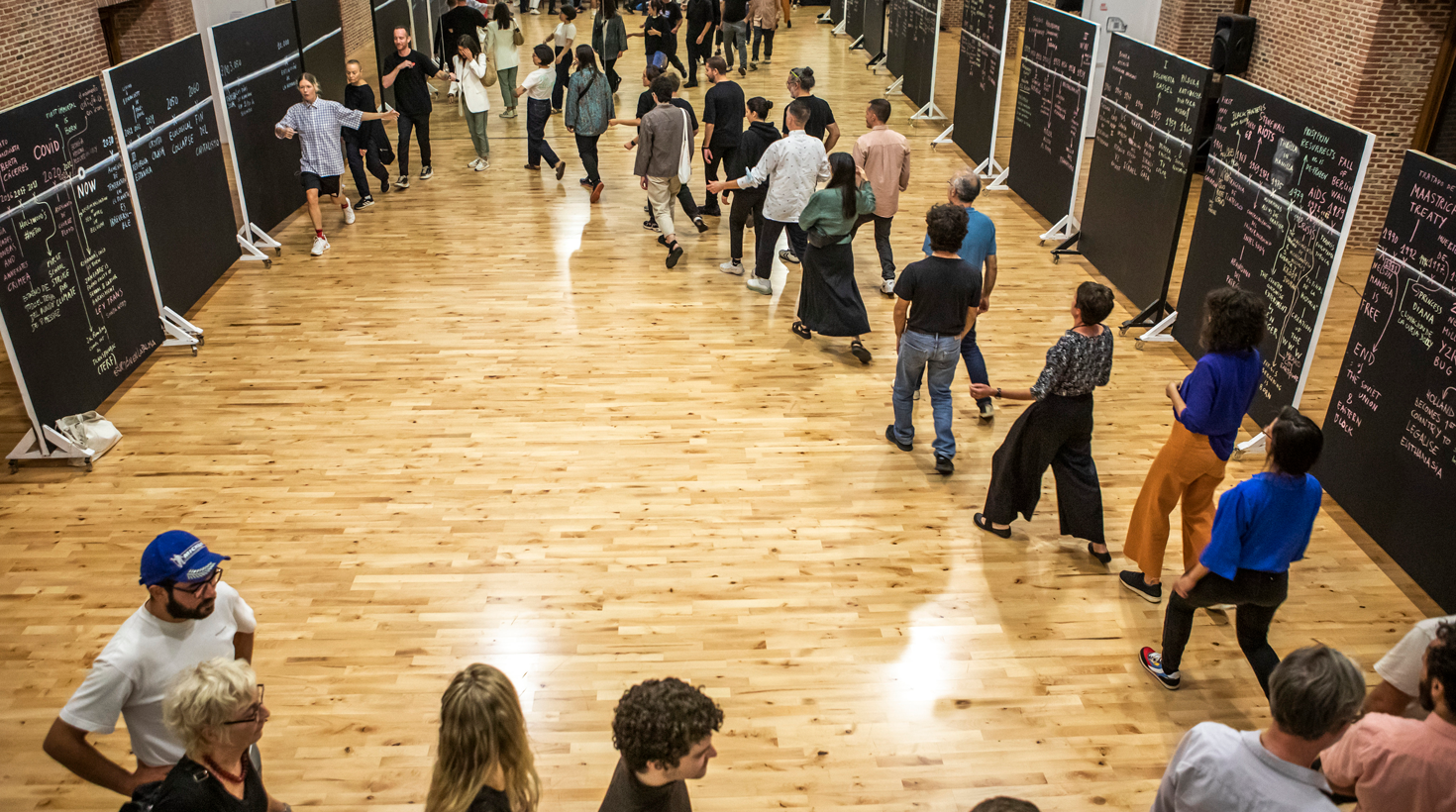
Obsessed with this story, Dora García creates a performance with seven performers and the audience in which she imagines a collective author who asks what happens over a period of fifty years, who or how what has happened is told, and who decides which events have transformed the world in that span of time.
The proposal (which has a variable duration depending on the space in which it is performed) imagines a story repeated in a cyclical way, a kind of eternal return that nevertheless has a flaw, a parasite, an insect, a bug, which prevents this repetition from flowing without victims. Each presentation of this performance involves the audience in a different activity: sometimes it is a lecture, sometimes a workshop, or perhaps a dance class or a skating exhibition, and sometimes, a theatre play. Here the hierarchies between performer and spectator, between the one who explains and the one who listens, are subverted.
El Bicho (like the performance Corocuerpo, also included in the Grec programme), is part of the artistic project Extramurs of the Museu Tàpies, which conceives the city as a space of intervention and mediation. With a multidisciplinary and plural approach, it fosters inter-institutional dialogue, with public space and with the environment. With the ongoing collaboration of EINA Centre Universitari de Disseny i Art de Barcelona and the Grec Festival Barcelona, among others, the Extramurs project proposes interventions and activities that respond to contemporary needs and foster new community narratives in the urban space. The gesture of considering the walls of public space as carriers of citizens’ voices, spaces where collective discourses materialise and shared experiences are re-signified connects us directly with Tapiès’ thinking.
On an annual basis, each edition of the Extramurs project expands from the Museu Tàpies into public space in collaboration with the Grec Festival of Barcelona and other city institutions. For the 2026 edition, the artist Dora García has been invited. Dora García works mainly in the visual arts, and occasionally collaborates in the fields of dance and theatre, or engages in social and political contexts. The work of Dora García spans literature, cinema, installation and performance, and focuses on stories that she herself constructs and stages, to create situations designed to involve the visitor and provoke unique and introspective experiences.
Within the framework of the Museu Tàpies project Extramurs 2026, curated by Imma Prieto, director of the Museu Tàpies, and Judith Barnés, head of public programmes at the Museu Tàpies.

| 
|
Dates and tickets
Free event with prior invitation required
Performance for audiences of all ages.
Artistic profile
- Performance
- Dora García, Simón Asencio, Persis Bekkering, Michelangelo Miccolis, Adriano Wilfert Jensen, Castillo, Krõõt Juurak
- Acknowledgements
- IUAV Venezia, KHiO Oslo, DeSingel & M KHA Antwerp; and to the students of the course THE BUG at the National Academy of the Arts in Oslo.
- Production
- Museu Tàpies, the Gran Teatre del Liceu and Grec 2026 Festival of Barcelona