

From 17 March to 1 April, the Gran Teatre del Liceu presents Manon Lescaut, the first great success of Giacomo Puccini. Àlex Ollé’s contemporary production, conducted by Josep Pons, moves the drama to present-day Europe and portrays Manon as an undocumented immigrant. With Asmik Grigorian and Joshua Guerrero leading the cast, the Liceu offers an intense and moving operatic experience that connects with the full emotional power of Puccini’s music.




The Gran Teatre del Liceu presents Manon Lescaut, Puccini’s first great tragic love story, in a contemporary production by Àlex Ollé with maestro Josep Pons conducting, from 17 March to 1 April.
Manon Lescaut, an opera in four acts premiered in 1893 at the Teatro Regio in Turin, is based on L’histoire du chevalier des Grieux et Manon Lescaut (1731) by Abbé Prévost, which also inspired the opera Manon by Jules Massenet.
With the premiere of Manon Lescaut, Puccini emerged as one of the world’s great opera composers and the natural heir to Giuseppe Verdi. It was here that he first displayed the full power and the most recognisable traits of his style: immortal melodies, strong orchestral force, a powerful dramatic sense and believable characters, with a particular emphasis on the heroic and tragic dimension of his female protagonists.
A production that redefines Manon in the 21st century
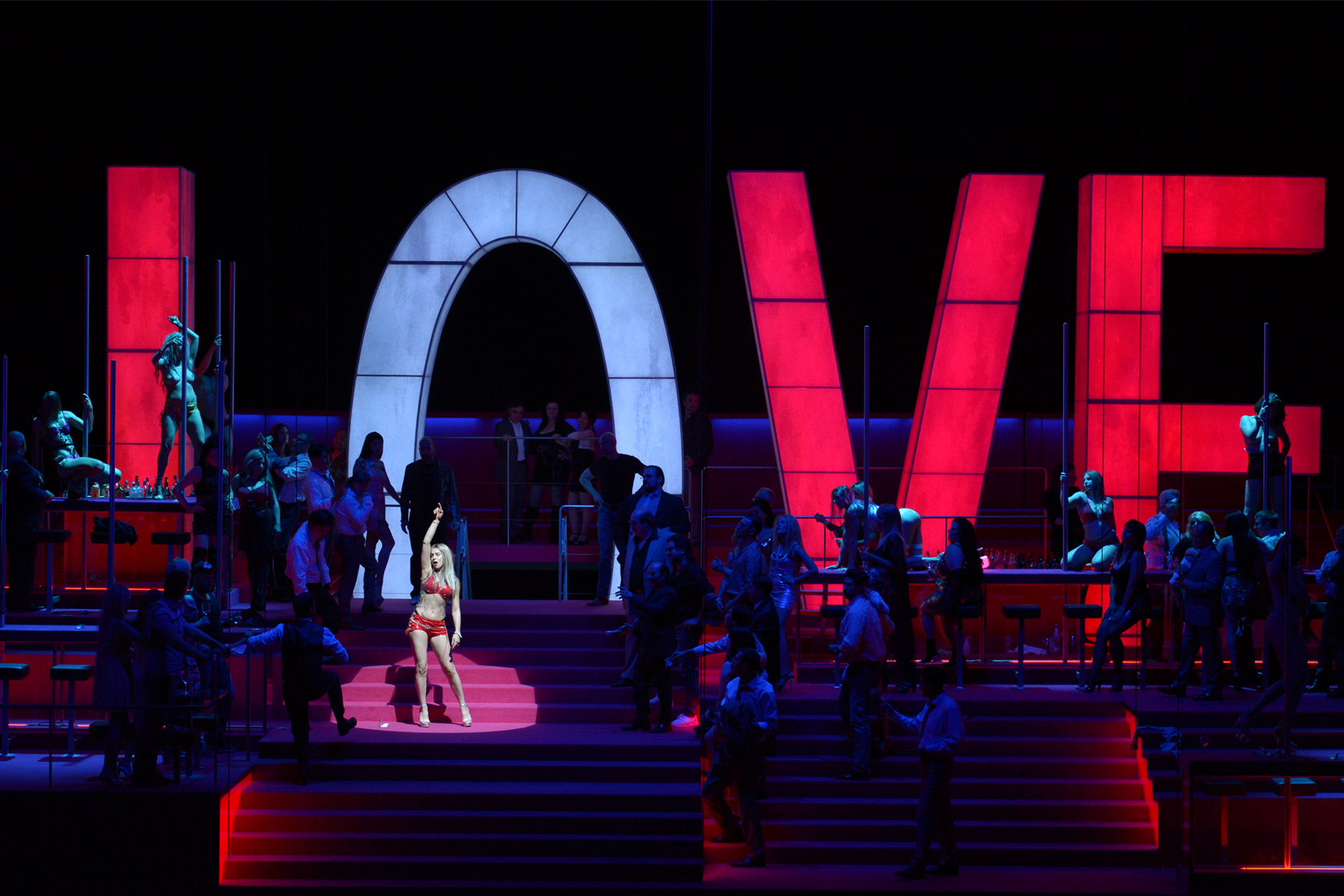
Àlex Ollé’s staging, originally created for the Frankfurt Opera, places Manon Lescaut in a striking contemporary context. At the beginning, projections show Manon and her brother Lescaut crossing a border fence and entering as undocumented immigrants. The harassment she suffers triggers a spiral of abuse and exploitation that runs throughout the story.
With urban costumes by Lluc Castells and sets by Alfons Flores, Ollé places these characters—consumed by love and torn between virtue and desire—within spaces that are recognisable today: a bus station, a nightclub where Manon becomes the star, and claustrophobic cells serving as a prelude to deportation. The constant presence of giant letters spelling the word LOVE acts as a visual reminder of the unpredictable and devastating passion that drives the opera.
Soprano Asmik Grigorian, one of today’s most outstanding voices, takes on the title role with a performance of great vocal and dramatic intensity. Alongside her, American tenor Joshua Guerrero brings Des Grieux to life. The Manon imagined by Ollé is innocent and vulnerable, yet also capable of unwavering passion and an indomitable will.
In this interpretation, Manon could come from anywhere in the world: she flees misery, war or social degradation, or has been seduced by the mirage of an idealised Europe. From this premise, the dramaturgy proposes a contemporary reinterpretation of the myth. Manon dies from exhaustion, sorrow and despair. Her truest love is the fierce love of someone who refuses to give up the hope of a better future; her desert is the infinite solitude before the fence that ultimately separates her from that future.
The four acts unfold in sordid and oppressive spaces. The first places us in a bus station, where it is suggested that Manon may fall victim to a human trafficking network, with Geronte willing to pay for her. The second transforms Geronte’s house into a setting of degradation and abuse. The third presents a suffocating prison, close to a centre of dehumanisation. Finally, the fourth act, set in the Louisiana desert, is the most austere: the stage is almost empty, with the sole presence of the structure that throughout the opera has formed the four letters of LOVE.
A cast equal to the opera’s dramatic intensity
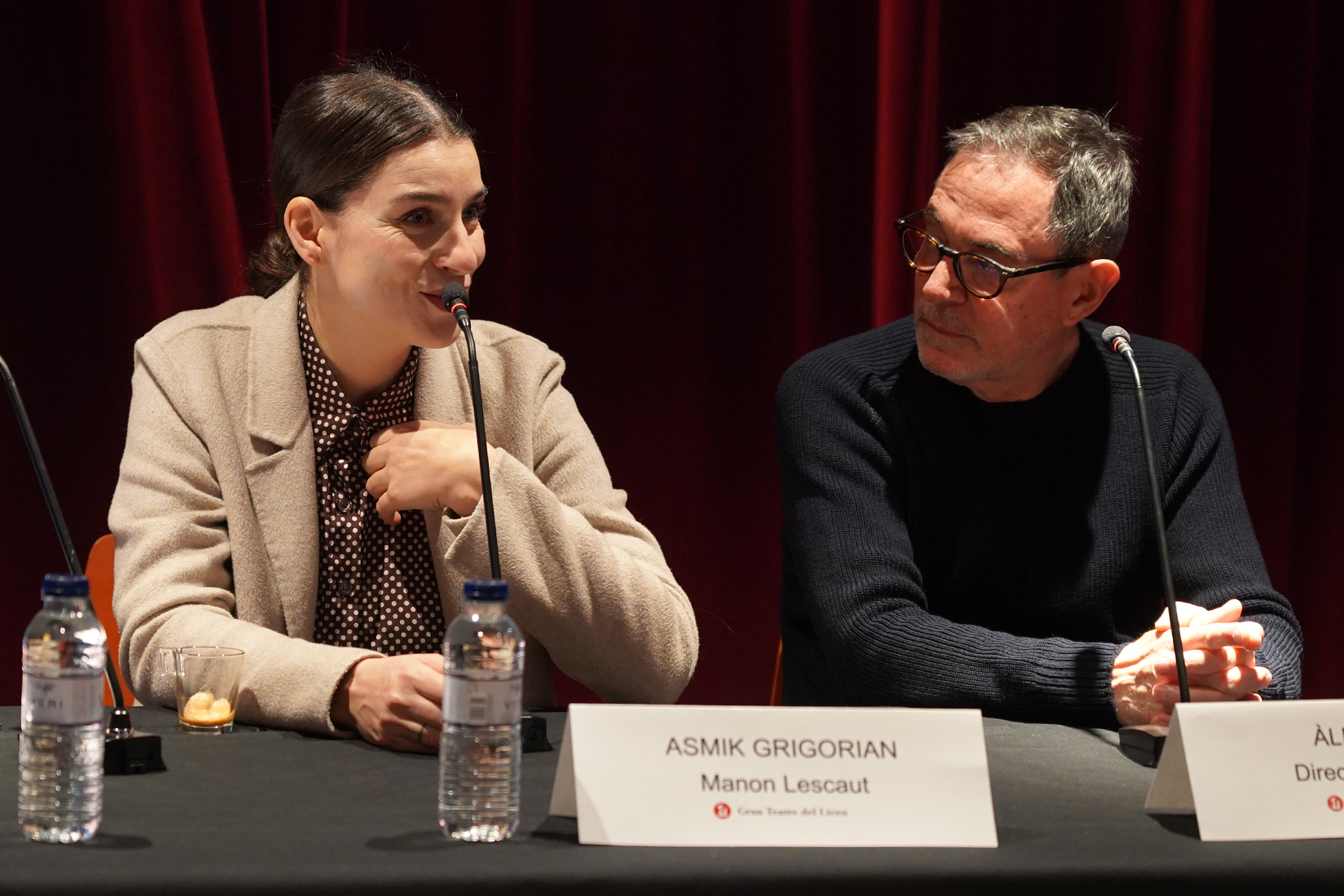
The lead of this production is Lithuanian soprano Asmik Grigorian, one of today’s great operatic voices, returning to the Gran Teatre del Liceu after her recent success in Rusalka. Grigorian takes on the role of Manon with the courage and physical intensity that define her. If in that production she impressed with great physical demands, here she faces another highly challenging stage role, enhancing the dramatic depth of the character.
Puccini’s Manon is highly complex: it combines lyrical moments of intense emotion (such as the final aria Sola, perduta, abbandonata) with the psychological evolution of a young woman moving from innocence to tragic awareness of her fate. The role demands physical strength, timbral beauty, and expressive power, qualities that converge in Grigorian’s performance.
Alongside her, American tenor Joshua Guerrero brings Renato des Grieux to life, with iconic arias like Donna non vidi mai and passionate duets with Manon, such as Vedete? io son fedele. The cast is completed by Belarusian baritone Iurii Samoilov as Lescaut and Italian bass Donato di Stefano as Geronte di Ravoir, a role usually reserved for highly experienced voices.
The secondary roles (Edmondo, the Dance Master, and the Musician) are performed by Croatian tenor Filip Filipović, Valencian tenor Álvaro Diana, and Argentine soprano Mercedes Gancedo, respectively.
The sumptuous score, rich in colour, is characterised by youthful vitality and full of glorious melodies: from the passionate duet between Des Grieux and Manon, Vedete? io son fedele, to the overwhelming desolation of Manon’s final aria, Sola, perduta, abbandonata, passing through Donna non vidi mai from Act I and In quelle trine morbide from Act II.
The plot
The story begins with the meeting of the noble young gentleman Renato des Grieux and Manon, an undocumented immigrant who has just arrived in a new country and must find a new life. She is accompanied by her brother Lescaut and the elderly Geronte, who is ready to seduce her with money and promises of luxury. But Des Grieux acts first: he falls in love with Manon at first sight and proposes they run away together. She agrees, and they embark on a love-driven adventure.
However, Manon is drawn to the comfort and stability that Geronte can offer. Unable to resist the temptation of luxury, she abandons Des Grieux and becomes the wealthy protector’s mistress. The memory of her first love, however, haunts her. When the young lovers reunite, Des Grieux forgives her, and they decide to escape together, taking jewels and money. Their flight fails: Manon is arrested by the police.
In the third act, she is imprisoned and sentenced to exile in Louisiana, a French colony in North America where criminals and prostitutes were sent. Des Grieux, desperate, bribes the captain of the ship crossing the Atlantic to accompany her. The journey, however, leads not to freedom but to tragedy.
In the final act, the couple crosses a harsh desert, hoping to reach English territory. Exhausted, without water or strength, Manon collapses. She dies in Des Grieux’s arms, confessing her love. He, steadfast and loyal, cannot prevent the fatal outcome. All efforts have been in vain.

Àlex Ollé, resident artist at the Gran Teatre del Liceu
Stage director Àlex Ollé, resident artist at the Liceu and responsible for the staging of Manon Lescaut, was recently awarded Best Stage Direction at the Ópera XXI Awards for his work on Lady Macbeth of Mtsensk, the opera with which the Liceu inaugurated the 2024/25 season. In the same awards, set designer Alfons Flores, also responsible for the sets of Manon Lescaut, was recognized with the Best Set Design award for the same title. Additionally, Ollé has been honored with the Liceu Gold Medal in recognition of his artistic career and connection to the institution.
He was one of the artistic directors of La Fura dels Baus from its beginnings until 2023. His stage direction career spans multiple genres: theatre, opera, film, and large-scale productions. Among his early works are the trilogy Accions (1984), Suz/O/Suz (1985), and Tier Mon (1988), which established La Fura dels Baus as an internationally acclaimed cult company and created its distinctive language. His involvement in the opening ceremony of the 1992 Barcelona Olympic Games marked a turning point, both in terms of innovation for events of that scale and for the company’s history.
In opera, Àlex Ollé has directed over thirty-five titles, eight of them with Carlus Padrissa. He has worked in more than forty theatres worldwide, including the Royal Opera House in London, the Opéra National de Paris, La Scala in Milan, the New National Theatre in Tokyo, the Sydney Opera House, Teatro Real in Madrid, the Salzburg Festival, the Arena di Verona, and, of course, the Gran Teatre del Liceu.
This extensive career led him, five seasons ago, to be appointed resident artist at the Gran Teatre del Liceu. His most recent commission for the theatre was Lady Macbeth of Mtsensk by Shostakovich, which opened the 24/25 season.
Ollé also leads the Òh!pera project, “newly created micro-operas,” which promotes opportunities for young creators across all artistic disciplines involved in opera creation, helping to renew its language and shape 21st-century opera, with Ollé mentoring the project for the past five seasons.
With the support of: