

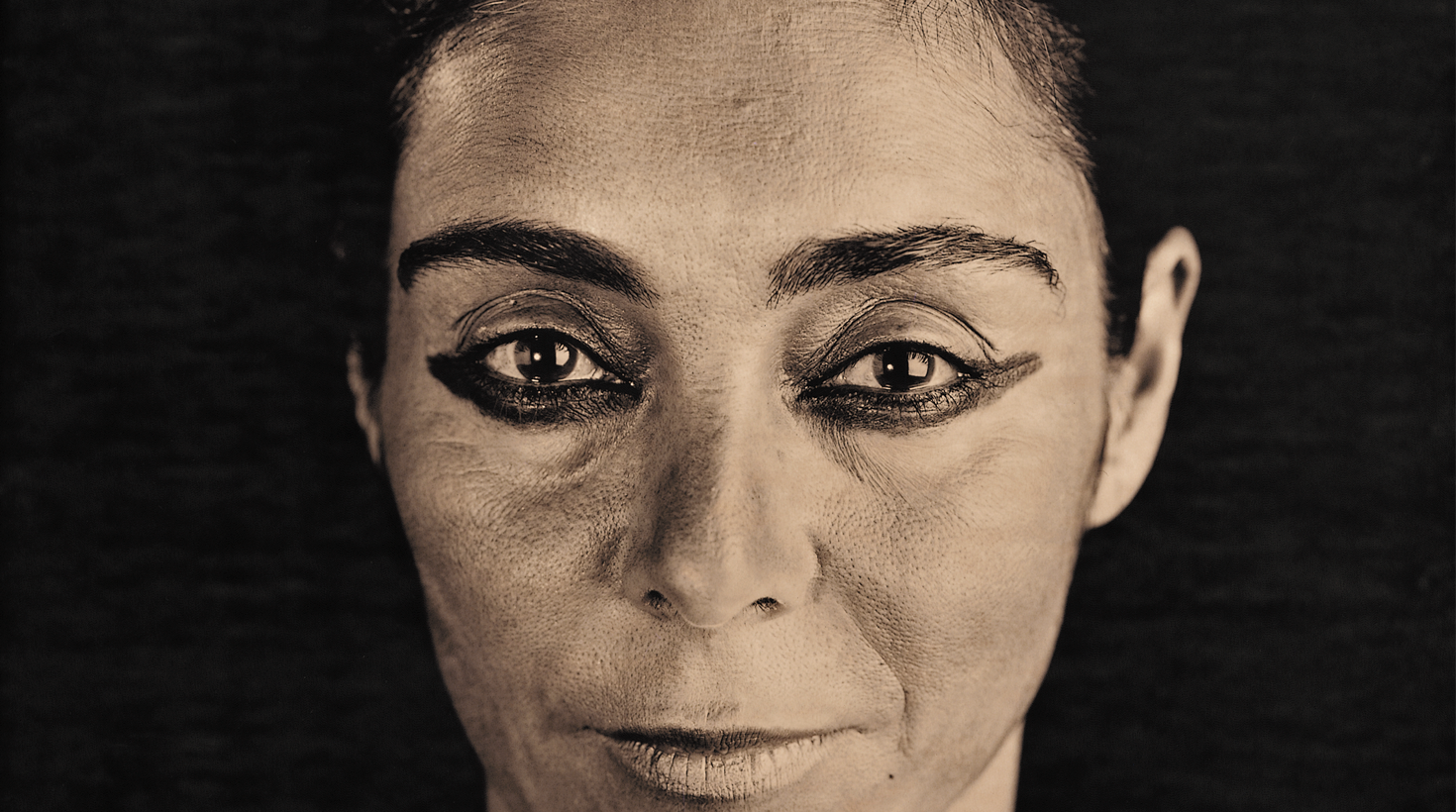
“Identity is not a place to arrive at, but a field of forces in constant tension”
Shirin Neshat
Photography occupies a central place in her career, especially in now iconic series such as Women of Allah, in which the superimposition of the female body, Persian script, and symbols of resistance generates an iconography that is as beautiful as it is unsettling. Neshat uses black and white with an almost liturgical precision and turns the image into a space of silence charged with meaning, in which the viewer’s gaze is directly and uncomfortably addressed. The body, often frontal and hieratic, is never passive: it is a territory of struggle, an archive of memory, and a surface of ideological projection.
Beyond explicit denunciation, her work is characterized by a profound poetic ambiguity. Neshat avoids a univocal narrative and constructs images that inhabit the border between intimacy and collective discourse, between tradition and modernity, between the individual voice and the chorus of a shared experience. This constant tension gives her work a universal force that transcends the specific context of Iran to speak about displacement, uprooting, and identity in a fragmented world.
In parallel with the production of Verdi’s Aida, which we will be able to enjoy on stage, in the Hall of Mirrors of the Gran Teatre del Liceu the presence of Shirin Neshat establishes a subtle dialogue with the space. The photograph presented there —as a suspended instant, as a gesture of silent resistance— opens a space for contemplation and questioning and invites us to listen to what the image does not explicitly say, but which resonates with profound intensity. In this encounter between art, gaze, and history, Neshat’s work reminds us that all identity is, in essence, an act of poetic resistance.
In parallel with the production of Verdi’s Aida, which we will be able to enjoy on stage, in the Sala Tenor Viñas and, with an introduction by Shirin Neshat herself, we will be able to view some video works. A subtle dialogue in which each narrative and poetic instant is a gesture of silent resistance. A contemplation that raises questions and at the same time invites us to listen to what the image does not explicitly say, but which resonates with profound intensity. In this encounter between art, gaze, and history, Neshat’s work reminds us that all identity is, in essence, an act of poetic resistance.
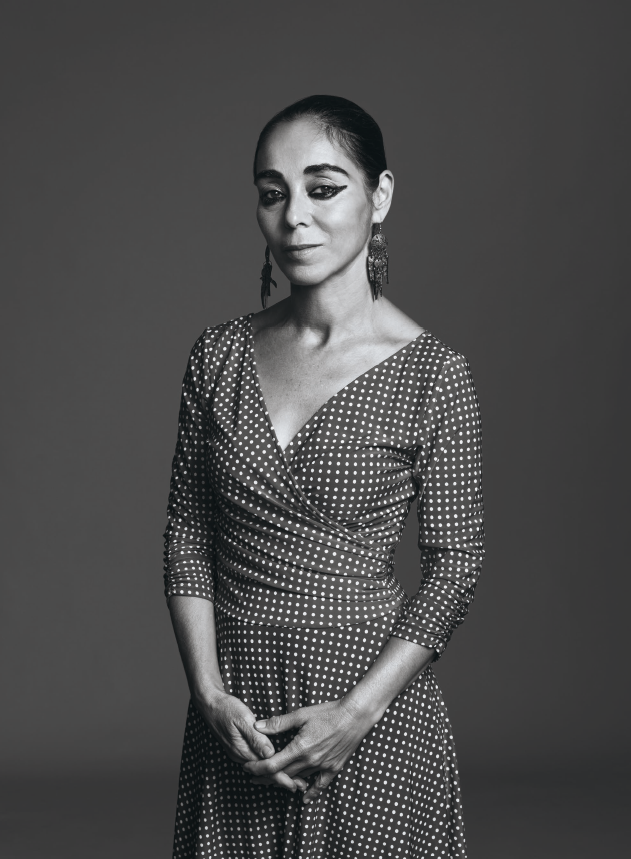
Shirin Neshat
Shirin Neshat (Qazvin, Iran, 1957) is one of the most incisive and poetic voices in contemporary international art. From exile, her artistic practice has built a visual corpus of exceptional intensity, in which photography, film, and installation become instruments for reflecting on the body, power, memory, and the condition of women in contexts shaped by cultural and political conflict.