

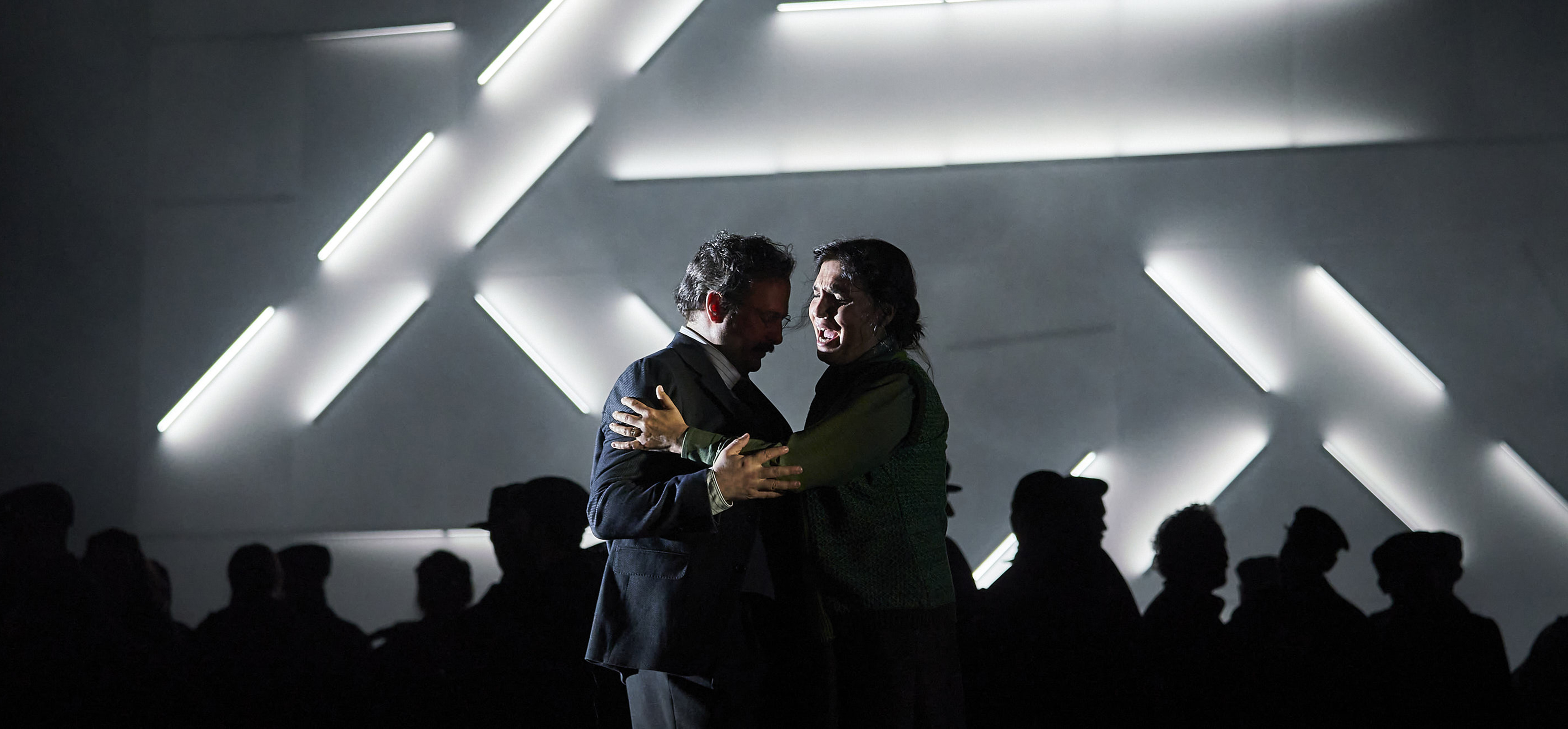
“Our opera begins and ends in Portbou. It is composed of 13 scenes —a magical number for Benjamin— that evoke 13 postcards from cities he travelled through during his life. The text is based almost entirely on authentic writings. As he wished to do with his completed Passages, we have created this opera out of quotations.” —Anthony Carroll Madigan, synopsis of the libretto for Benjamin in Portbou




Act 1, Scene I, Walter Benjamin, Lisa Fittko, the Hunchbacked Dwarf, Angelus Novus, chorus
«No matter… convictions don’t matter»
The opening scene of the opera sets the dramatic tone and musical aesthetic of the work: it primarily employs the vocal technique of sprechgesang introduced by Arnold Schoenberg, and presents Walter Benjamin in a moment of turmoil. He is trapped in Portbou, writing until the very last moment in an attempt to finish his final book, but he is tormented by uncontrollable forces: the Hunchbacked Dwarf who appears to him represents fatality—his imminent fate—while the luminous figure of the Angelus Novus symbolizes his future glory.
Act I, Scene VII, Walter Benjamin
«Quotations, quotations!»
In the previous scene, Walter Benjamin has met the Russian activist Asja Lācis, who seduces him in two ways: with her personal charm and charisma, and with her political ideas, aligned with the Bolshevik revolution. In Scene Seven, amid a marital crisis, Benjamin follows Asja to Moscow, but the visit turns out to be a complete disappointment: he returns not only with a broken heart, but also with a deep ideological disillusionment. The libretto reflects one of the central ideas of the work: that the majority of the opera’s text consists of quotations from Benjamin’s writings and correspondence.
“Divided into two acts and 13 scenes, the opera traces in the form of a long flashback the most significant episodes of Walter Benjamin’s life, culminating in his final day in Portbou.”
Act II, Scenes XII and XIII. Lisa Fittko, Walter Benjamin, Angelus Novus
«This won’t be easy. This man is really strange!»
After revisiting several episodes from Walter Benjamin’s life, the opera returns in its final two scenes to Portbou, where the guide Lisa Fittko has led the writer after crossing a Pyrenean mountain pass. Fittko foresees Benjamin’s tragic end, which is fulfilled in the final scene with the writer’s death. But it is no ordinary death: the symbolic figure of Angelus Novus—a spiritual alter ego of Benjamin who has hovered over much of the opera—manifests as a light and takes the protagonist’s place. At that moment, Benjamin crosses from the earthly to the transcendent realm, sealing his immortality.