

“A poem is a sign of innocence. As long as it limits itself to pointing. The poem must be gesture, only gesture. If it is anything else, it destroys innocence.”
Chantal Maillard
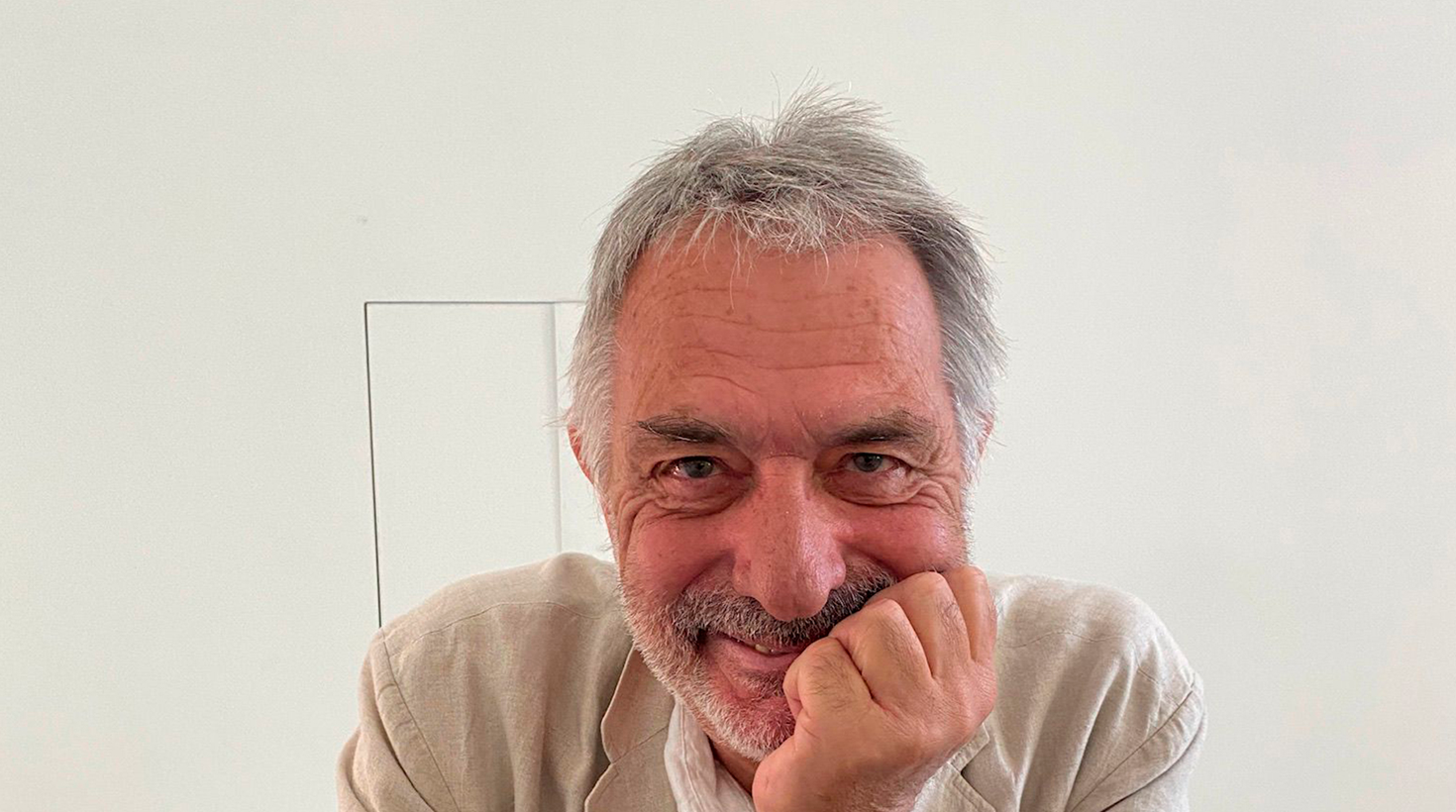
Frederic Amat (Barcelona, 1952) will be one of the guest artists of the 2026–2027 season at the Gran Teatre del Liceu. A singular figure and multidisciplinary artist, his contribution establishes him as a great mag-poet of the contemporary artistic scene. Painter, set designer, filmmaker, and transversal creator, Amat has developed a trajectory marked by a constant search for language, gesture, and the capacity of the image to generate experience beyond representation.
His work is structured as an open field of experimentation in which painting, drawing, object, space, and movement mutually contaminate one another. Color —dense, visceral, often wounded— becomes living matter, capable of constructing emotional spaces before recognizable forms. In Amat, the line does not describe; it erupts. Each gesture seems to arise from a physical, almost organic necessity, as if the image were the trace of an action that has taken place in a precise and unrepeatable moment.
Deeply connected to the world of performance, his work has been in continuous dialogue with theatre, opera, and music, bringing a visual perspective that understands space as a body in tension. His collaborations with creators from different disciplines have reinforced a conception of art as a relational act, in which the image does not exhaust itself but expands in time and in the viewer’s perception. This performative dimension runs through his entire work, even when it appears in seemingly static forms.
More than a style, Frederic Amat builds an attitude: a way of inhabiting creation through risk, intuition, and openness to the unknown. His work moves between abstraction and figuration without settling in any fixed territory, embracing instability as an essential condition of artistic practice. In this sense, each piece functions as a threshold, a passage space that activates the gaze and demands active engagement from the viewer.
Beyond the suggestive intervention in John Cage’s Ryoan-ji, Amat will also be present in the cherished Hall of Mirrors of the Gran Teatre del Liceu. There, he will establish a fluid dialogue with the site’s performative memory. The work presented does not merely occupy the space, but traverses it, activating its reflections, shadows, and theatrical dimension. In this encounter, image becomes action and color becomes voice. Amat thus invites us to experience art as a living event in which the gaze does not contemplate but participates.