

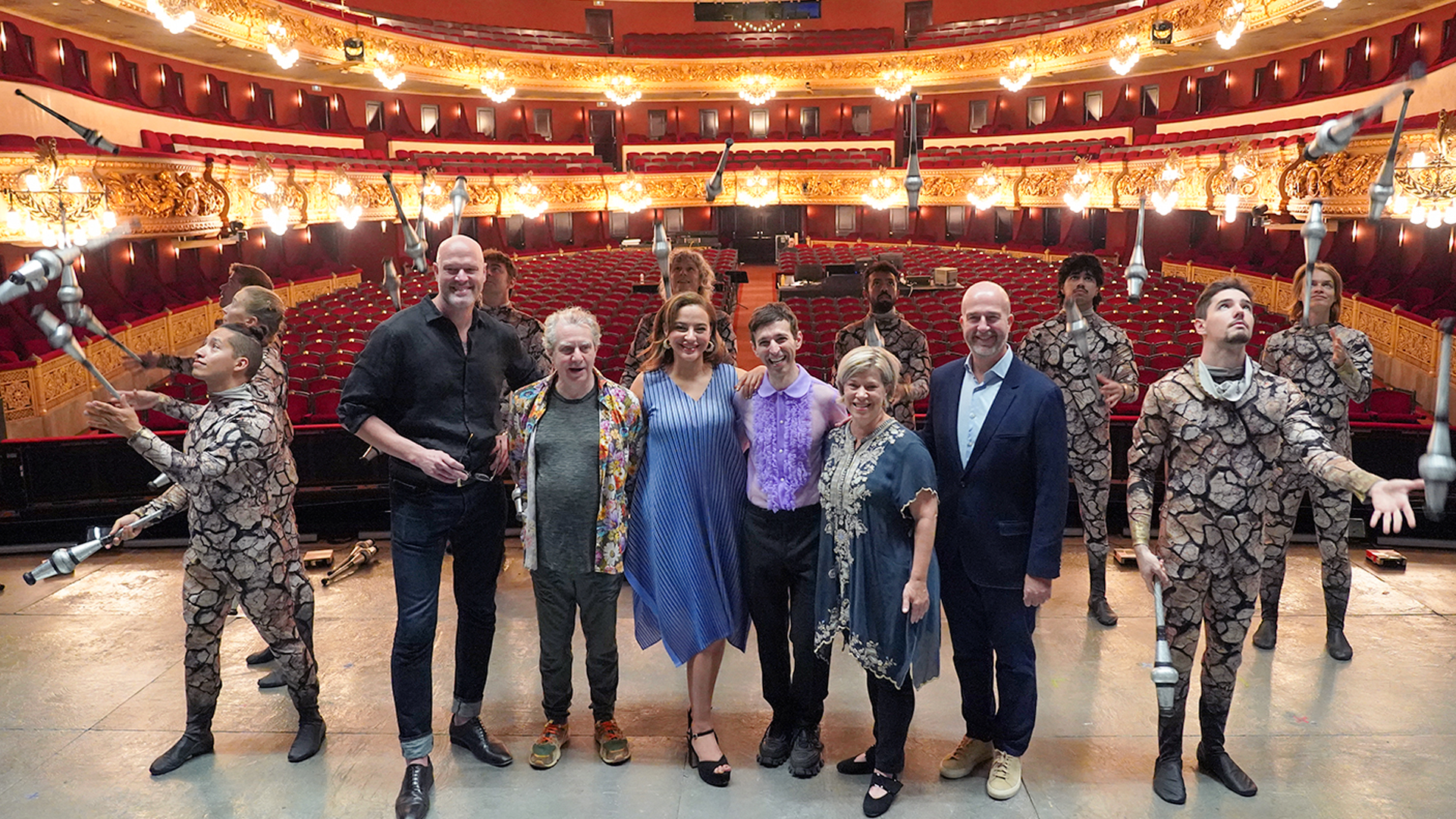
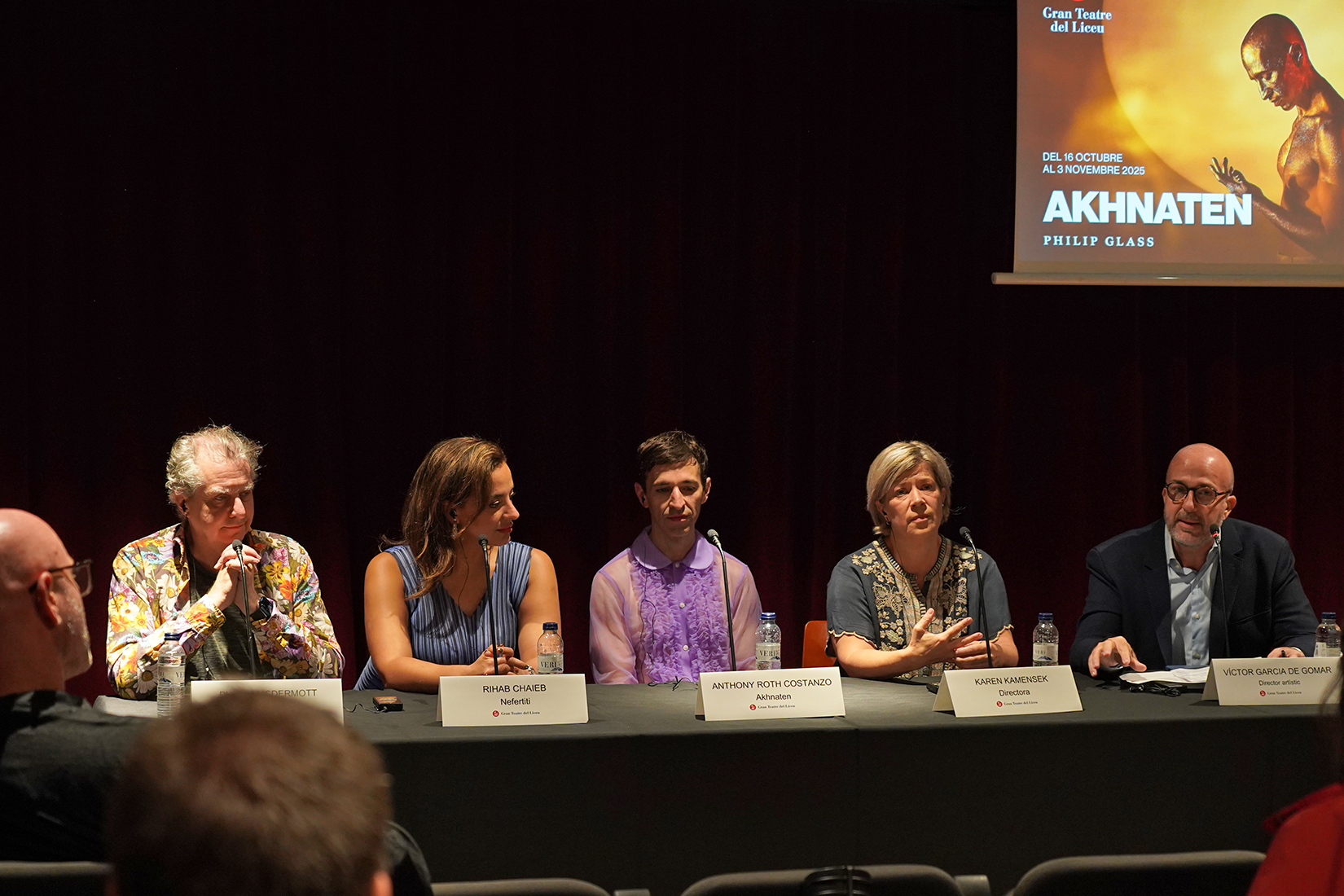
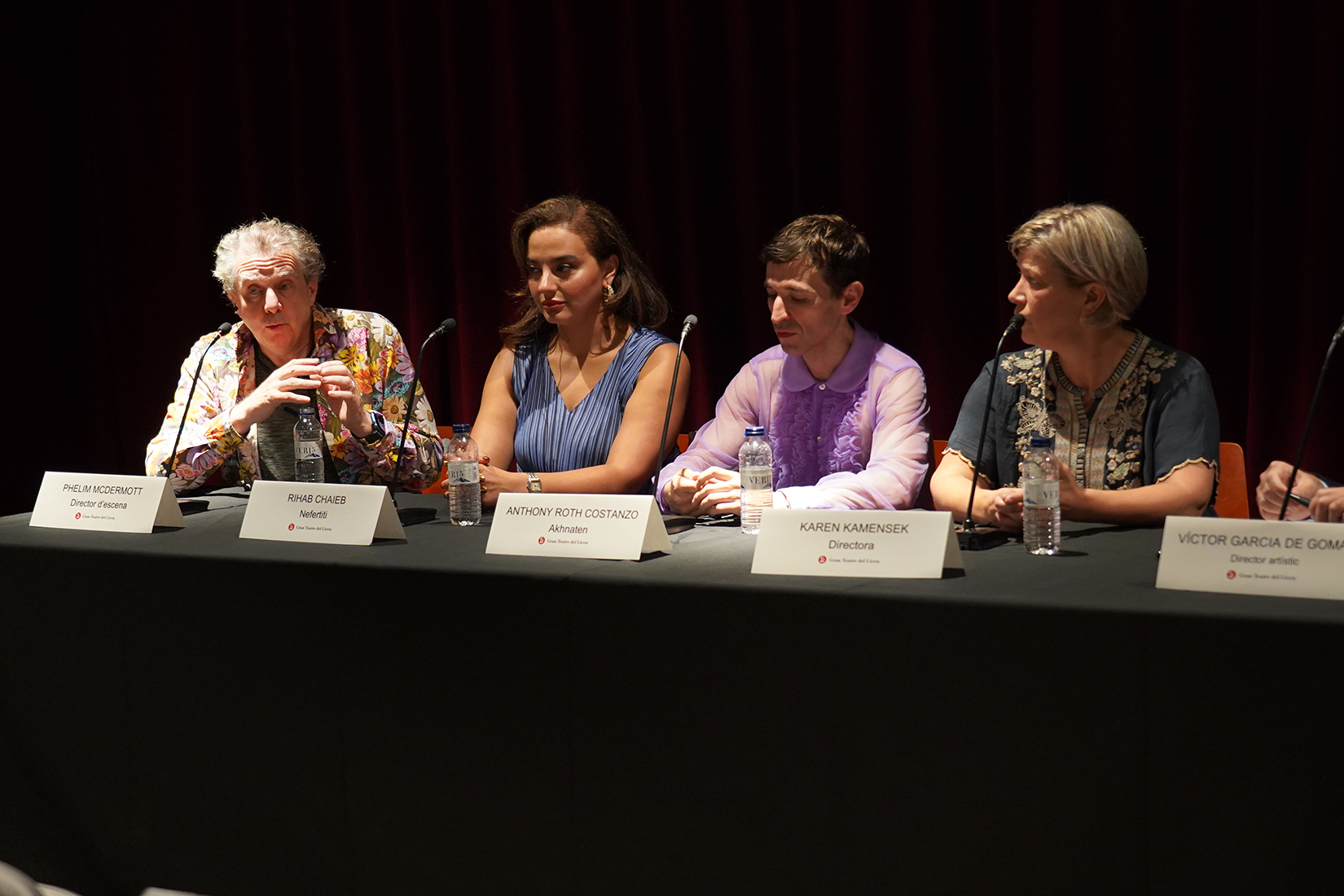
The Gran Teatre del Liceu presents the Spanish premiere of Akhnaten, Philip Glass’s hypnotic opera inspired by Pharaoh Akhenaten. This production by Phelim McDermott arrives following its success in London, Los Angeles, and New York. Countertenor Anthony Roth Costanzo and mezzo-soprano Rihab Chaieb make their Liceu debuts under the musical direction of Karen Kamensek. Akhnaten blends symbolism, visual beauty, and minimalist music to recreate the religious revolution that changed Egypt’s history.




Akhnaten, the final work in Philip Glass’s trilogy of minimalist operas, arrives at the Liceu for the first time in Spain with a majestic production directed by Phelim McDermott and conducted by Karen Kamensek. It stands as one of the most significant premieres in the country in recent decades. Akhnaten will be performed at the Liceu in a total of seven shows, from October 19 to November 3, with an exclusive Under35 session on October 16.
Between 1976 and 1980, Philip Glass premiered two music-theatre works —Einstein on the Beach and Satyagraha— that expanded the known boundaries of opera. These creations captivated an audience hungry for innovation and opened the door for Glass to compose another opera, Akhnaten, which completed his trilogy on revolutionary historical figures.
Akhnaten focuses on one of the most influential figures in human history: Akhenaten, the 14th-century BC pharaoh who broke with traditional Egyptian polytheism and initiated a monotheistic religious reform. The multi-award-winning countertenor Anthony Roth Costanzo takes on the complex title role, joined by Rihab Chaieb as Nefertiti. Bass Zachary James, winner of a 2022 Grammy and described as a “true stage animal,” a regular performer on Broadway and the West End, makes his Liceu debut as the Scribe.
Akhnaten: The epic conclusion of a visionary trilogy that reinvented opera in the 20th century
Although the extensive catalogue of Philip Glass (Baltimore, 1937) includes more than twenty works that can be considered operas, the New York–based composer has always sought to maintain a certain distance from the genre. The first time Glass ventured into the realm of musical theatre, he did so from the cutting edge of the avant-garde, taking an openly anti-traditional stance. The origin of Akhnaten dates back to the early 1970s. At the time, Glass was an emerging composer within New York’s downtown scene, which included figures such as composer Steve Reich —with whom he would later fall out— and playwright Robert Wilson.
Together with Bob Wilson, Glass composed Einstein on the Beach, presented at the Liceu during the 1992/1993 season. After its premiere and the success it achieved in Avignon and New York in 1976, Glass went from being an amateur composer to becoming the new sensation of the popular avant-garde. In 1980, he premiered Satyagraha —about the life of Mohandas Gandhi—, and in 1981 the Stuttgart Opera specifically commissioned a new work that would become Akhnaten, conceived by Glass as the conclusion of a trilogy about great historical figures: if Einstein represented science and Gandhi embodied politics, Pharaoh Akhenaten allowed him to explore religion. Three operas about individuals who changed the world.
Of Philip Glass’s first three operas, Akhnaten is the one with an operatic language closest to convention, while still remaining an experience aligned with avant-garde theatre rather than traditional opera. There are spoken and sung sections in English, such as the protagonist’s aria in the second act —until then, Glass’s stage music contained almost no text, or the text was expressed abstractly, as in Einstein on the Beach, or in a dead language, as in Satyagraha— as well as a love duet and a trio, along with a powerful choral presence. And, most importantly, Akhnaten has a narrative. The opera follows the life of the pharaoh divided into several acts, beginning with the funeral of his father, Amenhotep III, and continuing with his coronation, before depicting the religious revolution he instigated: abandoning the pantheon of Egyptian gods to worship the single god Aton —Aten in the operatic text— who represents the solar disc.
From there, the opera depicts the construction of the city of Aton, Akhenaten’s life in the new capital, the rebellion of the priests, and the complete erasure of his history, with a time jump extending to the 20th century that allows the audience to take a step back and admire the power of the pharaoh’s transgressive message, which continues to resonate today, 3,500 years later.
A colossal production by Phelim McDermott
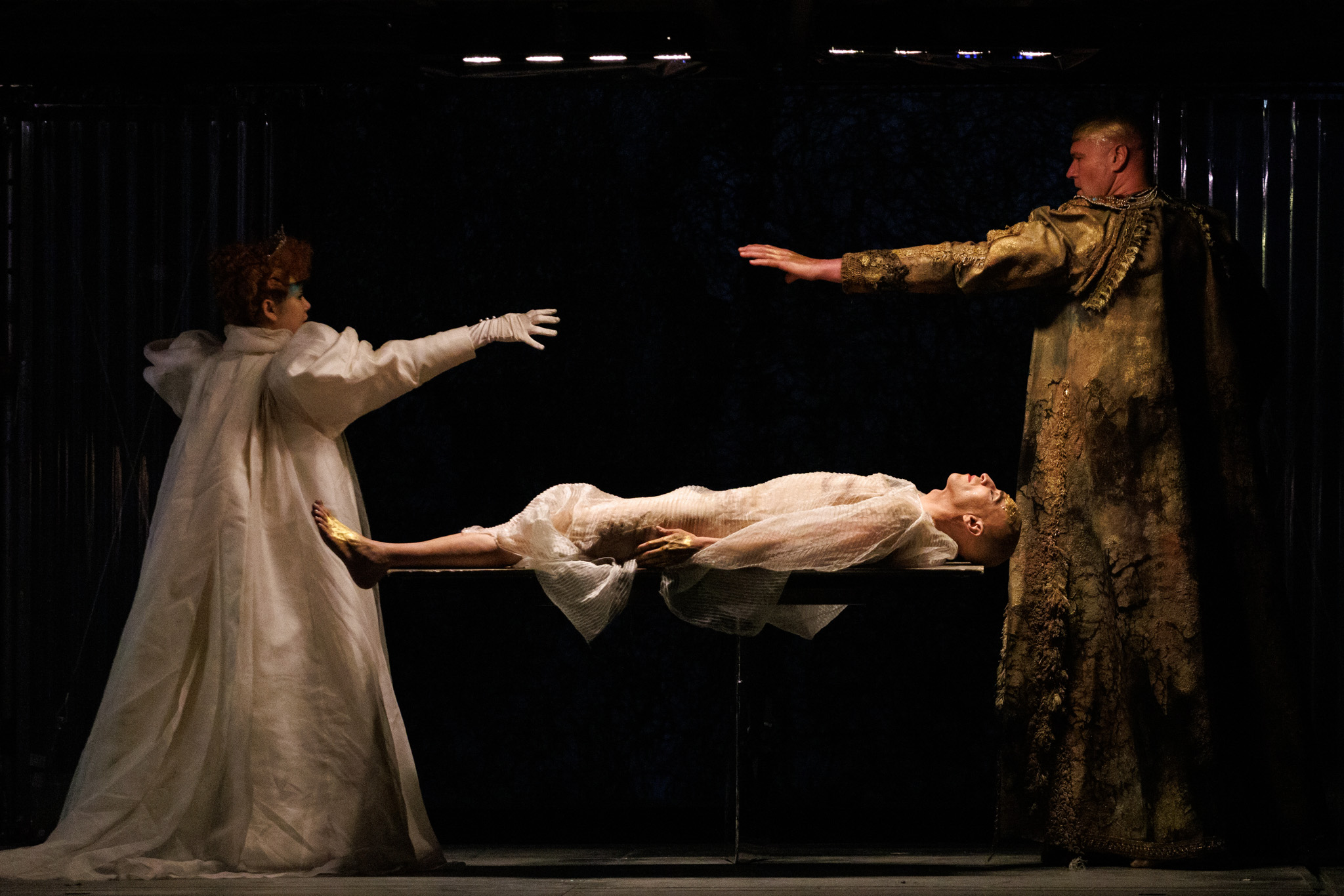
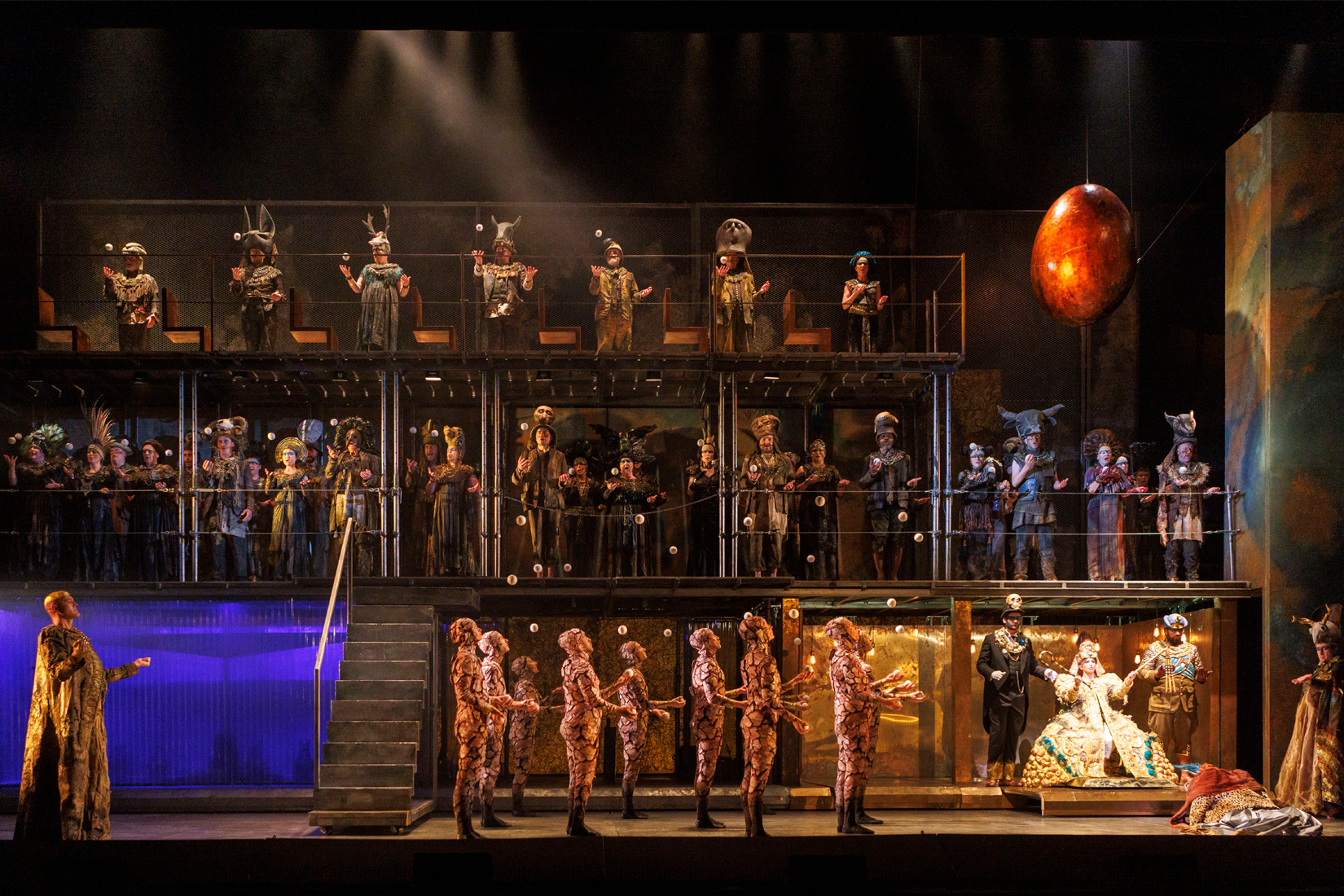
Stage director Phelim McDermott does not propose a realistic portrayal of ancient Egypt, but rather projects collective fantasies about the mythical era of the pharaohs. The production, filled with symbolism, ornaments, and references to Egyptian art, is monumental in scope, featuring exuberant architecture and dynamic stage action.
The work is structured as a series of scenes depicting well-known moments from the life of the pharaoh and his court, with a significant presence of Queen Nefertiti, his family, and his closest political circle. Akhnaten is not intended as a documentary opera, but as an immersion into the mystery of a figure who attempted a revolutionary way of thinking ahead of his time, blending reality and legend.
When McDermott was commissioned to revive Glass’s third opera for the English National Opera and premiere it in 2016, he chose to convey a mythical and idealized vision of ancient Egypt. Through various stage strategies, such as luxurious costumes, detailed characterizations, multi-level stage arrangements, and technical resources like 3D mapping of images onto the backdrop, Akhnaten becomes an exuberant fantasy full of symbolism and imagery evoking the time of the pharaohs.
Some stage spaces are created from architectural designs taken from preserved excavations, and hieroglyphs and figures from temple and tomb reliefs are projected onto the backdrop. At the same time, McDermott proposes costumes, makeup, and jewelry that are close to what is believed to have been used in that era. Furthermore, to compensate for the opera’s limited action, the stage is filled with elements such as fabrics, luminous backdrops, choreography, and a troupe of performers specialized in juggling. This is the most striking aspect of the production: the juggling accompanies the entire work, paralleling the frenetic flow of Glass’s minimalist music.
Minimalist universe and the aria Hymn to the Sun in catalan
Akhnaten (1984) culminates the trilogy through which Philip Glass transformed avant-garde opera. Although the composer has never felt comfortable with the term “opera,” with Akhnaten (following Einstein on the Beach and Satyagraha) he takes a decisive step toward reconciling tradition and experimentation. This approach to Pharaoh Akhenaten preserves Glass’s hypnotic, repetitive style while incorporating a more structured narrative and a musical language closer to the conventions of the genre.
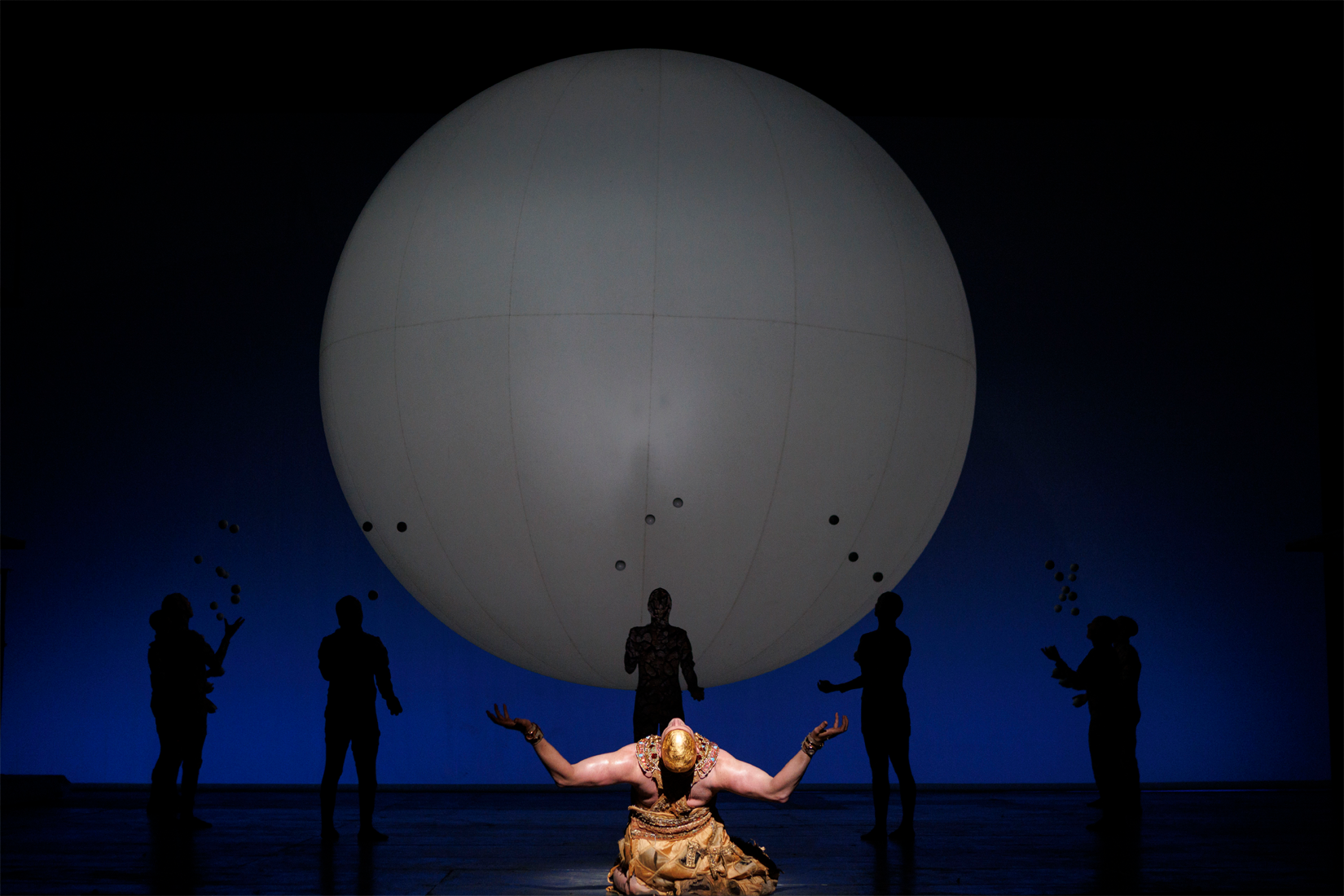
The opera opens with a prelude that introduces Glass’s characteristic atmosphere. The first scene, set during the funeral of Pharaoh Amenhotep III, combines the power of the chorus and orchestral intensity with striking percussion. Based on musicological studies, Glass recreates a possible ritual soundscape of ancient Egypt, reinterpreted within his minimalist universe.
In the second act, the duet Akhnaten and Nefertiti depicts the pharaoh and his wife beginning a new stage of the reign. It is one of the opera’s most demanding vocal passages: the countertenor and mezzo-soprano tackle an extremely high tessitura while the orchestra gradually builds to a climax of intense expressive power.
One of Akhnaten’s most emblematic moments is the aria Hymn to the Sun, based on an ancient text that, according to Glass’s instructions, is always performed in the language of the country where it is staged. At the Liceu, this hymn will be sung in Catalan —a special adaptation created to fit Glass’s music— which is remarkable given that the original text is in ancient Egyptian. In this passage, Akhenaten offers a prayer to the sun after consecrating the City of the Horizon to the god Aton. The excerpt, inspired by an inscription found in the ruins of Al-Amārna, is often attributed to the pharaoh himself and represents the protagonist’s highlight: an extensive countertenor aria illuminated by radiant orchestral accompaniment.
A specialized cast due to the extreme difficulty of Akhnaten
Akhnaten is an opera that demands specialist singers: performers must master texts in ancient Egyptian and endure long rehearsal sessions. Much of the artistic team presenting Philip Glass’s third major opera in Barcelona comes from the 2016 revival directed by Phelim McDermott for the English National Opera. Since then, the production has toured cities such as Los Angeles and New York, ensuring that the cast arrives in Barcelona with the work fully internalized.
The musical direction will be led by American conductor Karen Kamensek, an expert in Glass’s repertoire with a career spanning from 17th-century opera to contemporary compositions. American countertenor Anthony Roth Costanzo has portrayed Pharaoh Akhenaten since 2016, while Tunisian-Canadian mezzo-soprano Rihab Chaieb performs Nefertiti, demonstrating impeccable chemistry with Roth Costanzo.
Other notable roles include the Scribe, performed by bass-baritone Zachary James, and Queen Tye, played by soprano Katerina Estrada Tretyakova. Minor roles will be performed by local singers: Joan Martín-Royo and Toni Marsol as Horemheb and Aye, José Manuel Montero as High Priest of Amun, and Akhenaten and Nefertiti’s six daughters will be portrayed by Alba Valdivieso, Carmen Buendía, Mar Esteve, Carol García, Marina Pinchuk, and Anna Tobella.
With the exclusive sponsorship of:

|