


The Gran Teatre del Liceu presents Giulio Cesare by Georg Friedrich Händel, in a co-production with the Dutch National Opera, under the stage direction of Calixto Bieito. Maestro William Christie, one of the world’s leading authorities on the Baroque repertoire, will conduct the Liceu’s orchestra in a total of six performances. Barcelona-born countertenor Xavier Sabata and French soprano Julie Fuchs, two leading experts in 18th-century music, will take on the roles of Giulio Cesare and Cleopatra.




The Gran Teatre del Liceu brings Giulio Cesare by Händel to the stage, in a new co-production with the Dutch National Opera, which will be performed in a total of six shows, from 25 May to 7 June.
Renowned director Calixto Bieito returns to the Liceu to bring to life the love story of two great historical figures: Caesar and Cleopatra. An extraordinary Baroque work conducted by genre expert William Christie and featuring the voices of Xavier Sabata and Julie Fuchs.
For the first time in its history, the Liceu orchestra will perform a full opera using period instruments, following principles of historical performance. This approach allows for the recovery of the original sound with which Giulio Cesare was conceived, offering a listening experience faithful to the 18th-century aesthetic and highlighting the timbral richness typical of the Baroque.
Giulio Cesare is set in the past, but it is not a historical opera: its appeal lies in how it presents archetypes and human values adapted to the political interests of the 18th century. Bieito brings the opera into the present to explore, with a contemporary lens, the struggle for power, sexual obsession, the thirst for revenge, and the need for forgiveness in a world increasingly shaped by violence and selfishness.
Georg Friedrich Händel composed Giulio Cesare in Egitto in 1724, during an exceptional period in his career, when Italian-style opera was all the rage in London and he enjoyed the support of the British royalty to grow as a musician and impresario. The composer spent more time than usual refining its qualities: rich orchestration and melodies, and a dramatic depth rarely found in Baroque opera.
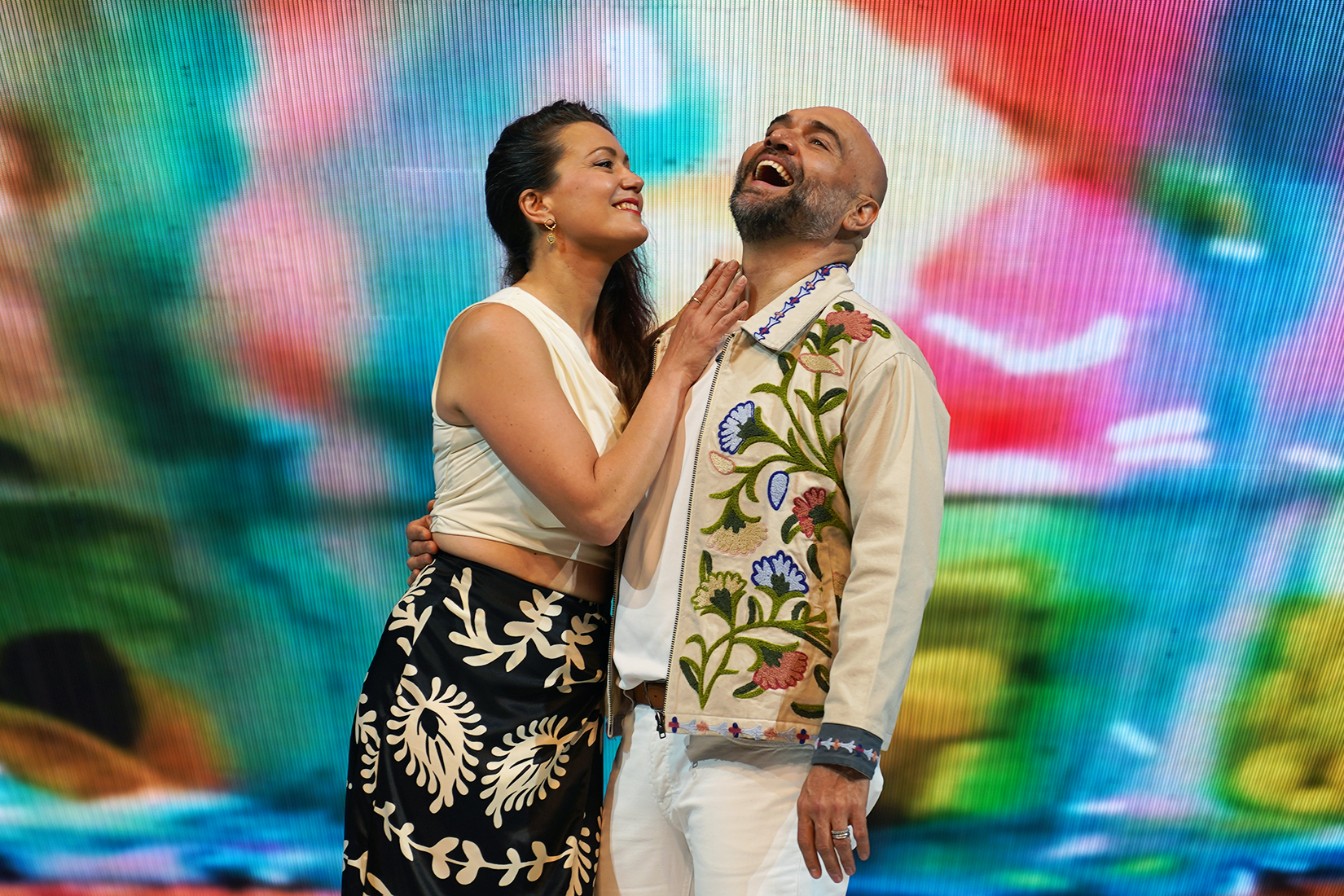
The production: a cruel caricature of the conquest of power
Calixto Bieito’s production focuses on the moral aspects of the story and, above all, on the dark side of desire and power. Like Händel and librettist Nicola Francesco Haym, Bieito approaches this opera not as a documentary account, but as an exploration of human nature and the characters’ deepest motivations.
Premiered in Amsterdam in 2023 to great acclaim, this production sets the action in an undefined present, suggested primarily through the costumes. The stage design is functional and almost clinical, with a mobile structure at the centre that allows for multiple effects of presence and disappearance. Beyond the aesthetics, what defines Bieito’s vision is the psychological intensity of the characters and how the tension between their desires drives the narrative forward to a paradoxical conclusion: Cesare triumphs not through force, but through apparent generosity and compassion, represented in a final gesture as iconic as it is provocative — the offering to Cleopatra of a throne that is, in Bieito’s iconoclastic tradition, a toilet seat.
Far from gratuitous provocation, Bieito presents Giulio Cesare as an opera about power and the different moral positions from which one seeks to conquer or maintain it. Although the libretto suggests a victory of virtue over pettiness, Bieito’s direction implies that even Cesare’s nobility is self-serving. The final message is clear: power is never innocent, no matter how much it disguises itself as kindness.
The plot: seduction, power and revenge
Giulio Cesare in Egitto, by Händel, tells the story of the encounter between the Roman general Julius Caesar and Cleopatra, set amid the struggle for control of Egypt following Pompey’s death. When Caesar arrives in Alexandria, he becomes entangled in the dynastic conflict between Cleopatra and her brother Tolomeo, who seeks to rule the kingdom. Determined to regain power, Cleopatra seduces Caesar and gains his support. Meanwhile, Cornelia and Sesto, Pompey’s widow and son, seek revenge for his murder at the hands of Tolomeo. The opera weaves together passion, revenge, and power plays, featuring a clever and charismatic Cleopatra and a Caesar who, despite war and betrayal, ultimately triumphs through strategic prowess.
Over the course of his prolific career, Händel composed nearly 40 operas, and Giulio Cesare in Egitto is widely considered to display his most skilful musical writing and best character development. Händel worked on this piece under uniquely favourable conditions: with an excellent team at his disposal, a generous budget, and ample time to compose.

Giulio Cesare is based on several Roman historical texts —mainly on the poem Pharsalia by Marcus Annaeus Lucanus, written during the reign of Emperor Nero— that documented the civil war which, a century earlier, had pitted Julius Caesar against Pompey.
The opera flows naturally because the emotions expressed by the characters are universal: the ambition for power, the desire for revenge, compassion, the demand for justice, etc. All of this is accompanied by an impressive arsenal of arias —seven for Cleopatra and seven for Cesare, not counting those of the secondary characters—: duets, choruses, symphonies, and the most colorful and dense orchestral writing in Händel’s operas. A masterpiece that stands the test of time remarkably well.
On stage: legends and rising stars of Baroque music
Considered, in the positive sense, a rarity in Händel’s operatic catalogue, Giulio Cesare is the only title by the composer that has maintained a constant presence across four centuries. While many of his other works had to wait until the 21st century to be rediscovered, this opera was not only the most frequently performed during Händel’s lifetime, but also resurfaced sporadically in the 19th century, became a symbol of the composer’s revival in the 20th century, and remains his most iconic work in the 21st century.
This trajectory means that any new production of Giulio Cesare must meet a high level of artistic demand, with an audience accustomed to outstanding vocal and musical interpretations. In the performances hosted by the Gran Teatre del Liceu, the cast and artistic team fully meet this standard.
The musical direction will be led by the prestigious William Christie, a legendary figure in Baroque music who, at the age of 80, will make his debut at the Liceu conducting the theatre’s Symphony Orchestra. Founder of the renowned ensemble Les Arts Florissants, Christie will bring his insight to a score written for the finest voices in 18th-century Europe.
The lead role of Cesare will be performed by Barcelona-born Xavier Sabata, internationally acclaimed as one of the most prominent countertenors of his generation. Making her debut as Cleopatra will be the French soprano Julie Fuchs, one of today’s most celebrated voices in the 18th-century repertoire, known for her lyrical timbre and radiant projection. The cast is completed by Italian contralto Teresa Iervolino (Cornelia), mezzo-soprano Helen Charlston (Sesto), countertenor Cameron Shahbazi (Tolomeo), baritone José Antonio López (Achilla), Jan Antem (Curio), and Alberto Miguélez Rouco (Nireno), forming an ensemble of voices that highlights the balance, orchestral elegance, and vocal complexity of this great opera by Händel.
The Music
Giulio Cesare is one of Handel’s richest and most refined operas, and features some of the most celebrated arias in the Baroque repertoire. In each act, the music becomes a vehicle for emotional expression and a psychological portrait of the characters.
In Act I, Va tacito e nascosto, sung by Giulio Cesare, stands out for its brilliant trumpet accompaniment and reveals one of the Roman general’s virtues: prudence, as well as cunning in strategic matters. It depicts the moment when Pharaoh Tolomeo invites Cesare to a meeting to resolve their conflict following Pompey’s assassination, and offers him lodging at the palace. Though clearly a trap, Cesare accepts: it is better to keep one’s enemy close than beyond reach.
In Act II, V’adoro, pupille, sung by Cleopatra, is the central aria of the scene known as the Parnassus —a recreation, with musicians on stage, of the paradise from ancient mythology. Cleopatra aims to win over Giulio Cesare so he will help her reclaim the Egyptian throne, and upon learning that he has spent the night in the pharaoh’s palace, she does everything she can to draw him to her side. The aria becomes a weapon of seduction, with Cleopatra displaying all her charm and sophistication to captivate Cesare.
Finally, in Act III, we find two of the opera’s most profound and moving arias: Se pietà di me non senti and Piangerò la sorte mia, also sung by Cleopatra. In a moment of great vulnerability, believing Cesare to be dead, the Egyptian queen expresses her grief and despair with a musical intensity that combines formal balance and heartfelt emotion.
With the support of:

|
Funded by the Ministry of Culture within the framework of Barcelona’s Cultural Capital initiative promoted by the Ministry of Culture and the Barcelona City Council.

| 
|