

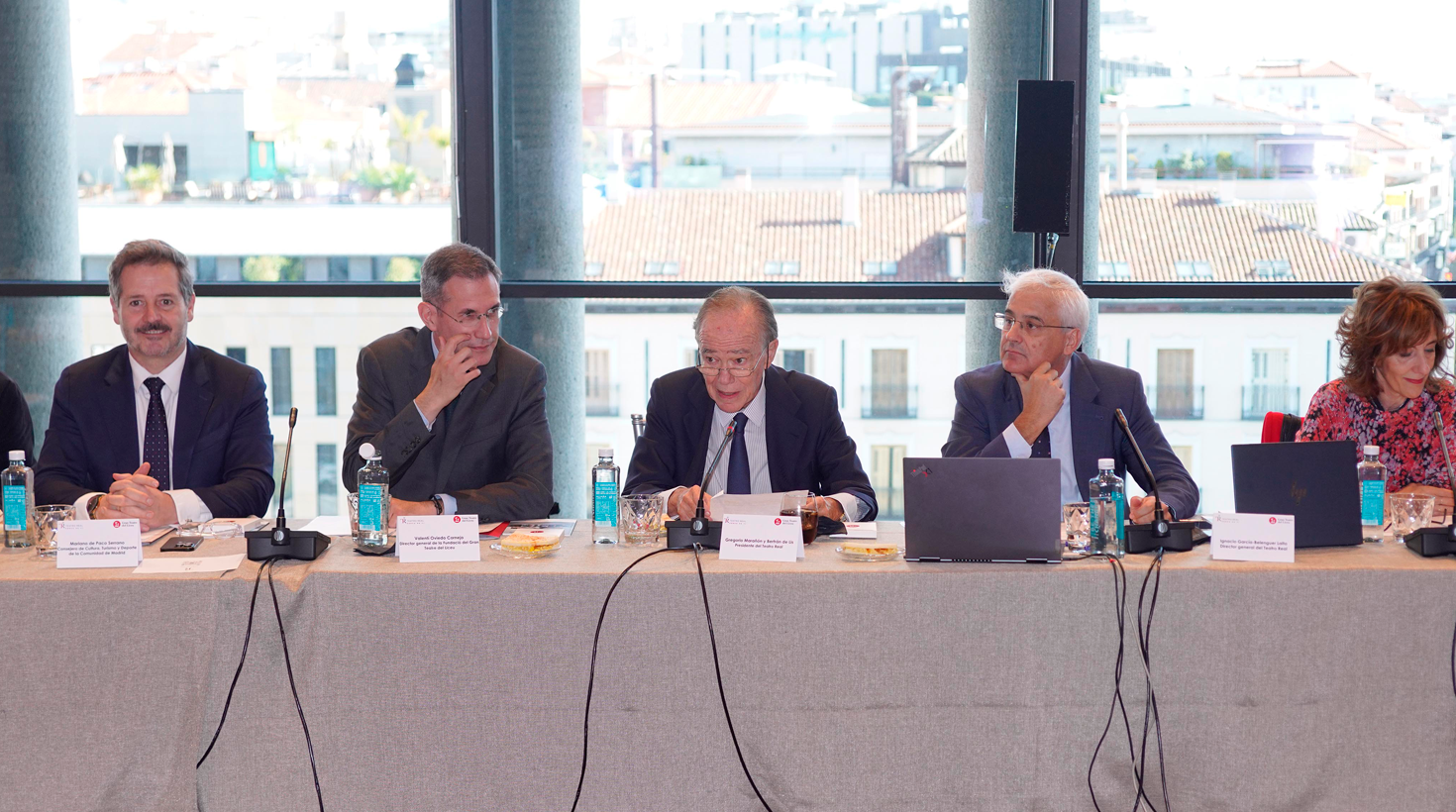
The meeting, chaired by the Minister of Culture, Ernest Urtasun, was led by Gregorio Marañón, president of the Teatro Real. Salvador Alemany, president of the Gran Teatre del Liceu, was unable to attend due to a last-minute indisposition and was represented by the Liceu’s general director, Valentí Oviedo. Several authorities from Madrid, Barcelona, and the Generalitat also took part. Both institutions shared challenges and solutions to build a solid future, adapted to modern times and to the needs of the operatic and cultural world.




Today, the Teatro Real hosted the fourth meeting of the Boards of Trustees of the Teatro Real and the Gran Teatre del Liceu —following those held in 2008 in Barcelona, 2017 in Madrid, and 2022 in Barcelona—, where both institutions analyzed the current situation of the operatic and cultural sector with the aim of finding a common space for work and collaboration, both artistically and institutionally, to face new challenges and consolidate strong, forward-looking initiatives.
The session was conducted with a shared conviction: that the union between the Teatro Real and the Liceu firmly demonstrates how culture has the power to bring societies together, humanize them, and build bridges.
The meeting, chaired by the Minister of Culture, Ernest Urtasun, was led by Gregorio Marañón, president of the Teatro Real. Salvador Alemany, president of the Gran Teatre del Liceu, was unable to attend due to a last-minute indisposition and was represented by the Liceu’s general director, Valentí Oviedo.
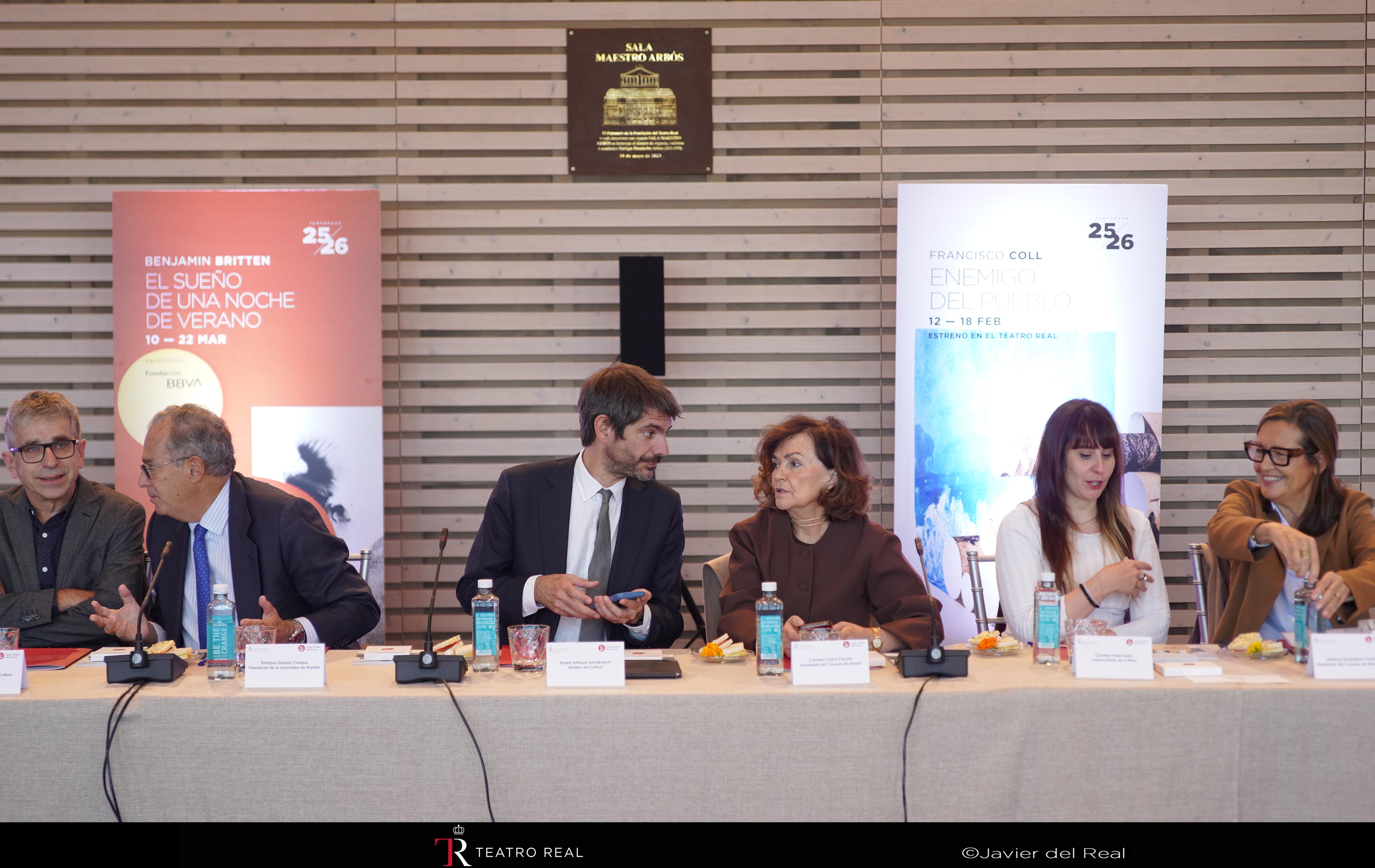
Attendees also included Enrique Ossorio, president of the Madrid Assembly; Carmen Calvo, president of the Council of State; Jordi Martí Grau, Secretary of State for Culture; Carmen Páez, Undersecretary of Culture; Xavier Fina, Director General of Cultural Promotion and Libraries of the Generalitat de Catalunya; Elisenda Rius, Manager of the Department of Culture, Education, and Life Cycles of the Barcelona City Council; Mariano de Paco, Minister of Culture, Tourism, and Sports of the Community of Madrid; and Marta Rivera de la Cruz, Delegate for Culture, Tourism, and Sport of the Madrid City Council.
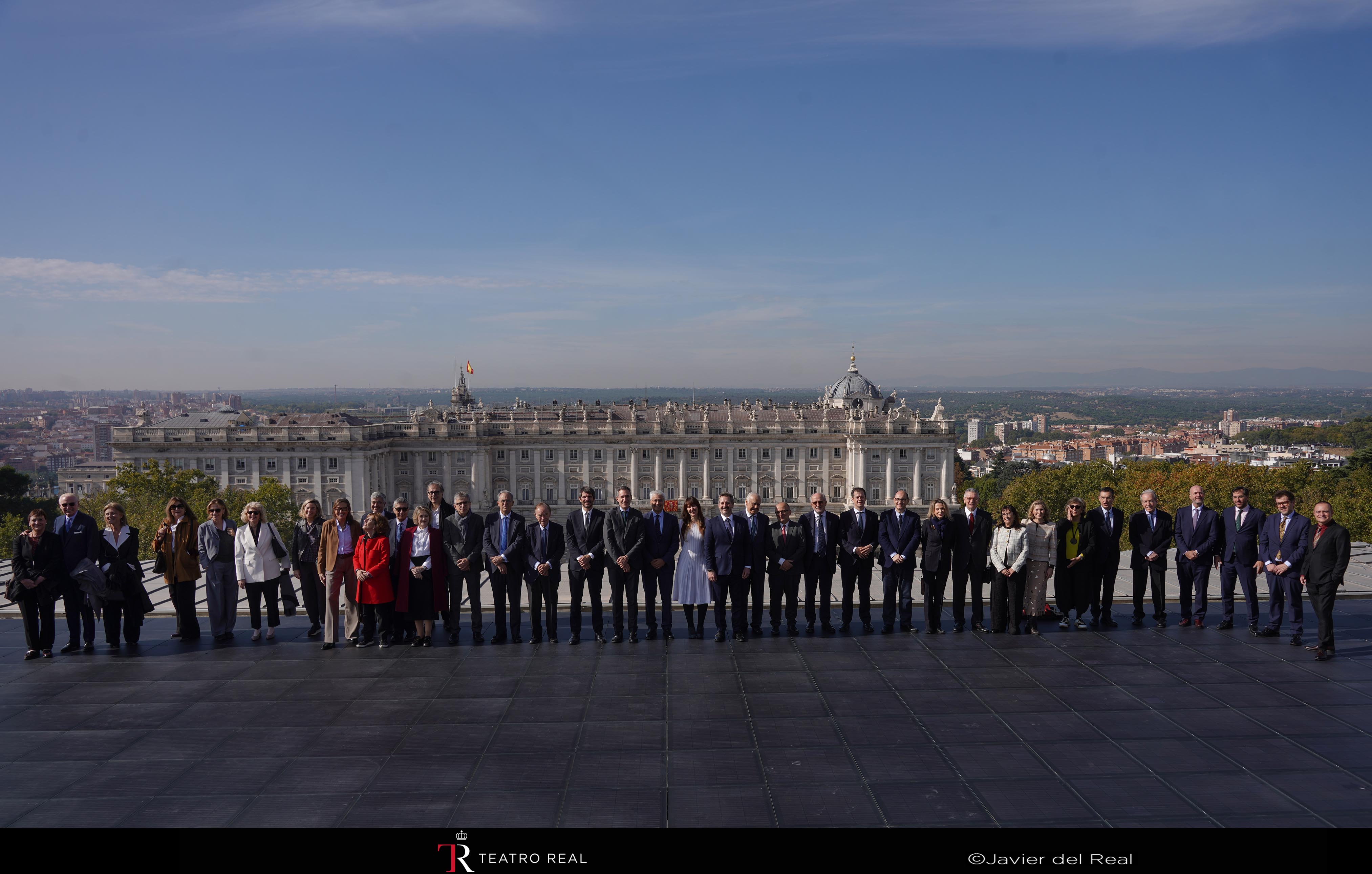
Before the session began, authorities and members of both boards visited the new installation of walkable photovoltaic panels —located on the roof of the Madrid theatre, making it the first historic building in the world to incorporate this technology— and learned in detail about the sustainability project that the Teatro Real has developed in recent years, making it the only Cultural Heritage Site (BIC) among the more than 16,000 registered in Spain to achieve near-zero energy consumption (EECN) and hold Energy Savings Certificates (CAE).
The Minister of Culture, Ernest Urtasun, highlighted the importance of “collaboration between institutions, the joining of efforts to generate living and transformative initiatives,” adding that “over the past four decades, our country has witnessed a true musical revolution that has placed us, in this field, at the level of excellence of other European nations. If there is one area where the democratization of culture has been most evident, it is opera.”
The president of the Teatro Real, Gregorio Marañón, underlined the “significant importance” of this relationship with the Liceu, which reflects their “deep mutual admiration” and the “determined will” to continue strengthening collaboration between both institutions.
Valentí Oviedo, general director of the Gran Teatre del Liceu, emphasized “the profound meaning of this meeting of boards,” conceived to “recognize one another, continue getting to know each other, and jointly thank the administrations and patrons for their constant support.” He also conveyed Salvador Alemany’s message that “it is precisely this support that allows us to continue building institutions which, through artistic excellence, make increasingly broad and equitable access to culture possible.”
Among the topics discussed at the 4th Joint Board Meeting between the Teatro Real and the Liceu —which, since the reopening of the Madrid theatre, have carried out more than twenty co-productions— was the need to ensure the generational renewal of qualified personnel in stage trades. The Liceu uses Dual Training programs, while the Real applies the SEPE’s Tándem initiatives, promoting the creation of workshop schools for young professionals.
Regarding digital transformation, both theatres propose that production planning migrate to a centralized platform to optimize resources; that the digital signature gain full legal validity and be extended to all contractual processes; that adaptation to the National Security Framework (ENS) be adopted as a governance policy; and that audience management evolve from transactional sales to personalized experiences, loyalty, and revenue optimization based on predictive data.
On the other hand, the Liceu and the Real consider it urgent to adopt legislative reforms, including raising the current thresholds for minor contracts, to simplify public procurement procedures —which are currently so complex that they sometimes end up blocking artistic hiring or the “management of liquid talent,” and therefore, the activity of the institutions.
The Teatro Real and the Gran Teatre del Liceu have developed joint projects such as a shared opera subscription or cross-promotions between their streaming platforms, My Opera and Liceu Opera+, the most recent of which took place on Opera Day (October 26).
Both institutions are at the midpoint of their respective strategic plans. During the board meeting, they highlighted some of their most recent milestones and main development lines. In the case of the Teatro Real, as recalled by its general director, Ignacio García-Belenguer, its significant advances in sustainability and international projection stand out, with tours such as the one to be carried out this month in China and others being prepared in the United States, Korea, and Japan. The development of the Real Teatro del Retiro —a reference space in Madrid for children and young people— and the growth of My Opera with new applications were also emphasized.
At the Gran Teatre del Liceu, key highlights include the expansion of its educational and social projects (LiceuAprèn and LiceuApropa), the creation of new small-format operas (micro-operas), and the consolidation of its digital platform liceuoperaplus.com. Looking ahead, the new Liceu Mar headquarters stands out as a space for innovation, training, and dance development, marking a new stage in the Liceu’s expansion.