

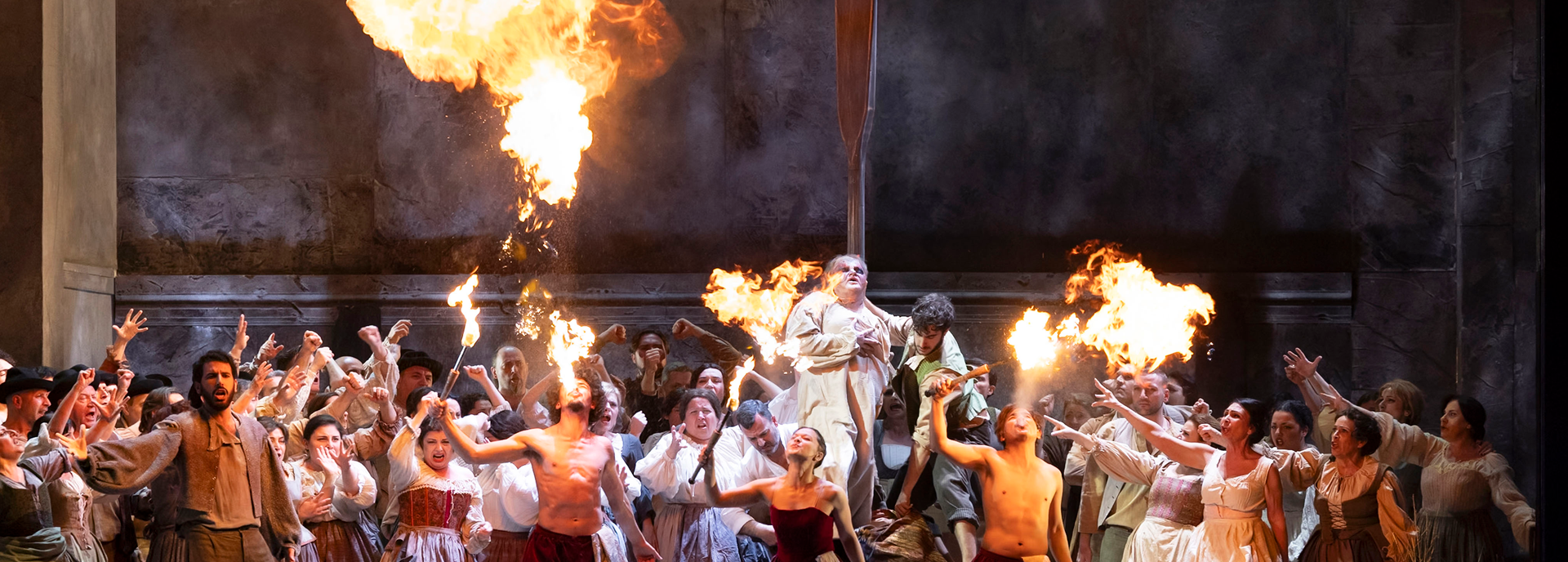
'La Gioconda' is the last great opera of the Italian Romantic period, a bridge between Verdi’s exalted dramas –it premiered after the maestro had retired from public life– and the verismo school led by Puccini. Inspired by the grandeur of Wagner and French opera, the story takes us to a dark and dangerous Venice where all human passions, from jealousy to hatred, from revenge to compassion, from faith to sexual desire, appear in their rawest form, without nuance.




La Gioconda is an opera completely inseparable from Venice. There are other titles in the repertoire that also have a direct connection to specific locations –this is also true, for example, of Tosca and Rome, or Andrea Chénier and Paris–, but in the case of Ponchielli’s work, the libretto specifies the locations of the action so precisely that any stage director would struggle to propose an abstract staging or move it to another city on a whim. Therefore, there are not many options: a production of this key piece of Italian Romanticism requires canals, marble staircases, bridges, and water, and moreover, it has reached a point where the audience cannot imagine a new performance of La Gioconda without it being accompanied by a tour of the lagoon city.
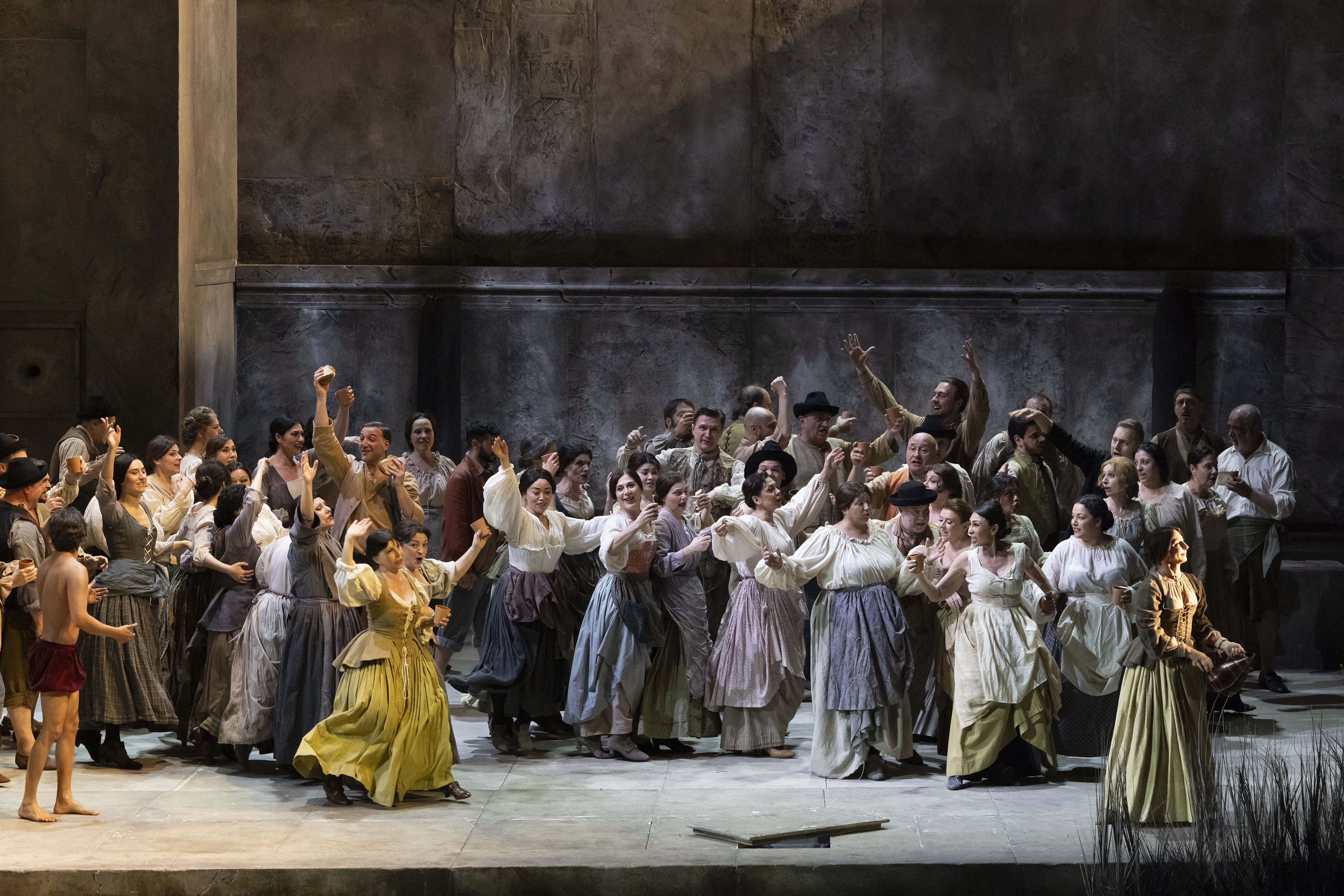
The young French stage director Romain Gilbert understood this, and when he was commissioned to create a new production of La Gioconda –by the Teatro San Carlo in Naples and the Gran Teatre del Liceu, which will align the 2026 performances with the 150th anniversary of the opera’s premiere in Milan– he decided that the presence of Venice was non-negotiable, but that he would construct a Venice different from the one shown in postcards and tourist guide photos. The libretto written by Arrigo Boito, for example, indicated that the first act should take place near the Bocca del Leone –an old mailbox for depositing anonymous complaints to the Venetian Inquisition– and more specifically, the one located on the first floor of the inner courtyard of the Palazzo Ducale, right next to the magnificent Scala d’Oro; the action extended to the Piazzetta –the end of St. Mark’s Square facing the lagoon– and to the entrance of the basilica at the far end of the courtyard. The third act takes place inside the Ca d’Oro –the most famous palace on the Grand Canal–, and the fourth in a dark location on the Giudecca island, traditionally the poorest and most sinister area of the city, where something terrible was always happening.
“Coinciding with the 150th anniversary of its premiere in Milan, the Liceu revives one of the key works of the Italian Romantic repertoire, a perfect storm of emotions”
Gilbert’s decision for the staging was ultimately to evoke a dark and treacherous Venice, but without falling into predictable literalism. For example, the set of the first act does not replicate the courtyard of the Palazzo Ducale, but it is still a grand Venetian setting –there is an open space, a noble building, a church, and water can be seen on the right– that anyone could encounter while walking through the city streets. At the same time, Gilbert has superimposed multiple versions of Venice: there is the luminous Venice, the one of Carnival and celebration, the one of joy, which is mainly conveyed in the third act with the famous Danza delle ore number, recreating a court ballet and the characters of the commedia dell’arte with historical fidelity thanks to the choreography of Vincent Chaillet and costumes by Christian Lacroix. But alongside monumental Venice, there is also nocturnal Venice, the one where crime and betrayal lurked around every corner. This is arguably the most successful scenic solution of the production, as it powerfully underscores all the evil that runs through the story, fitting well with the historical trajectory Venice began in the 19th century, when it became an abandoned, decadent city where centuries of wealth gave way to the proliferation of all kinds of ghost stories and grim tales.
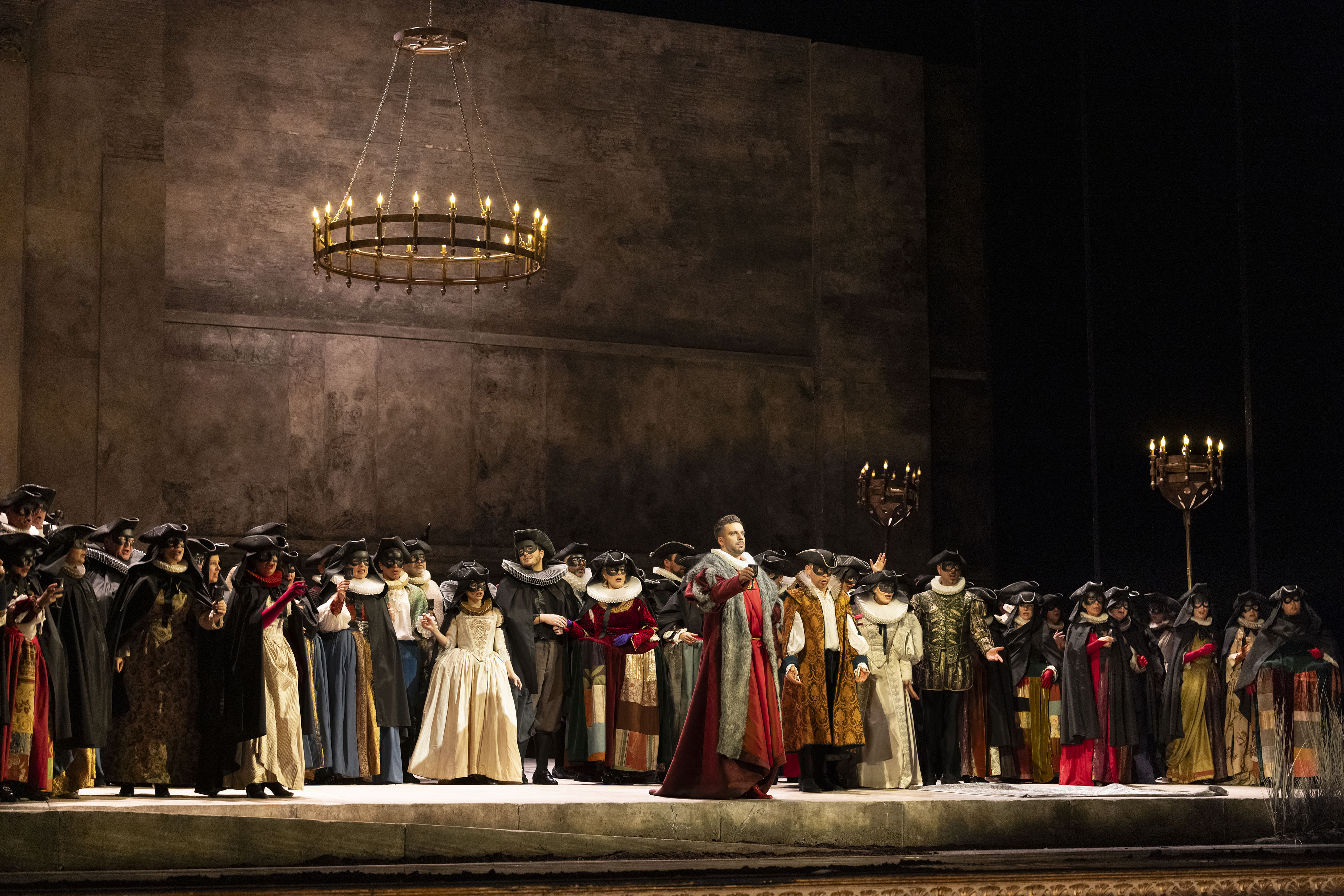
Thanks to the lighting work of Valerio Tiberi, the Venice presented in this production is immersed in chiaroscuro, effectively highlighting the moral forces at play in the story, the absolute evil represented by Barnaba, and the suicidal generosity of La Gioconda. In the first act, there is a balance between darkness and light; it is a moment in the story that takes place during the day, and there is still a margin of hope before the catastrophe unfolds. But as the acts progress, and the action moves to nighttime and secluded areas of Venice, the metaphorical weight of darkness grows increasingly heavy. In this way, Gilbert’s production accentuates the sense of fatality and the exponential rise of evil, culminating unbearably in the fourth act and the opera’s finale.
“Romain Gilbert’s production faithfully follows the libretto and presents a classical set design, with play of shadows, transporting us to 17th-century Venice”
It does so without having to force a situation that is, in itself, already exaggerated dramatically: Gilbert relies on an evocative location and timely lighting to create the right atmosphere, allowing the plot to unfold without distractions and the singers to perform at their best. The great value of La Gioconda lies in its collection of exceptionally beautiful melodies. This is a strong link in the historical chain connecting early 19th-century bel canto with the verismo generation of Mascagni and Puccini –whom Ponchielli, by the way, taught at the Milan conservatory–and moments of delicacy and passion emerge at the most unexpected times. It is a difficult opera to sing, and performers need everything around them to support focus and vocal effort. This production takes that into account, which is why it is so fitting: it immerses us in the story while rescuing us from all the darkness it contains, allowing the music, together with Venice, to take center stage.