

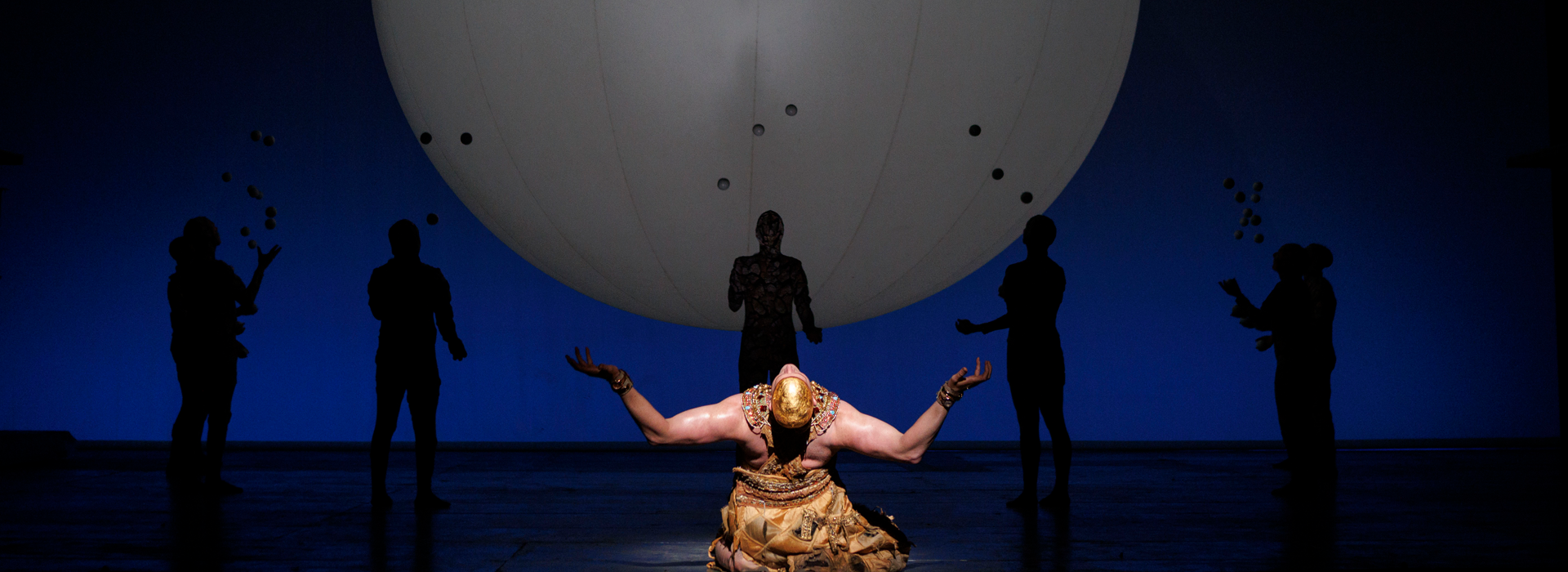
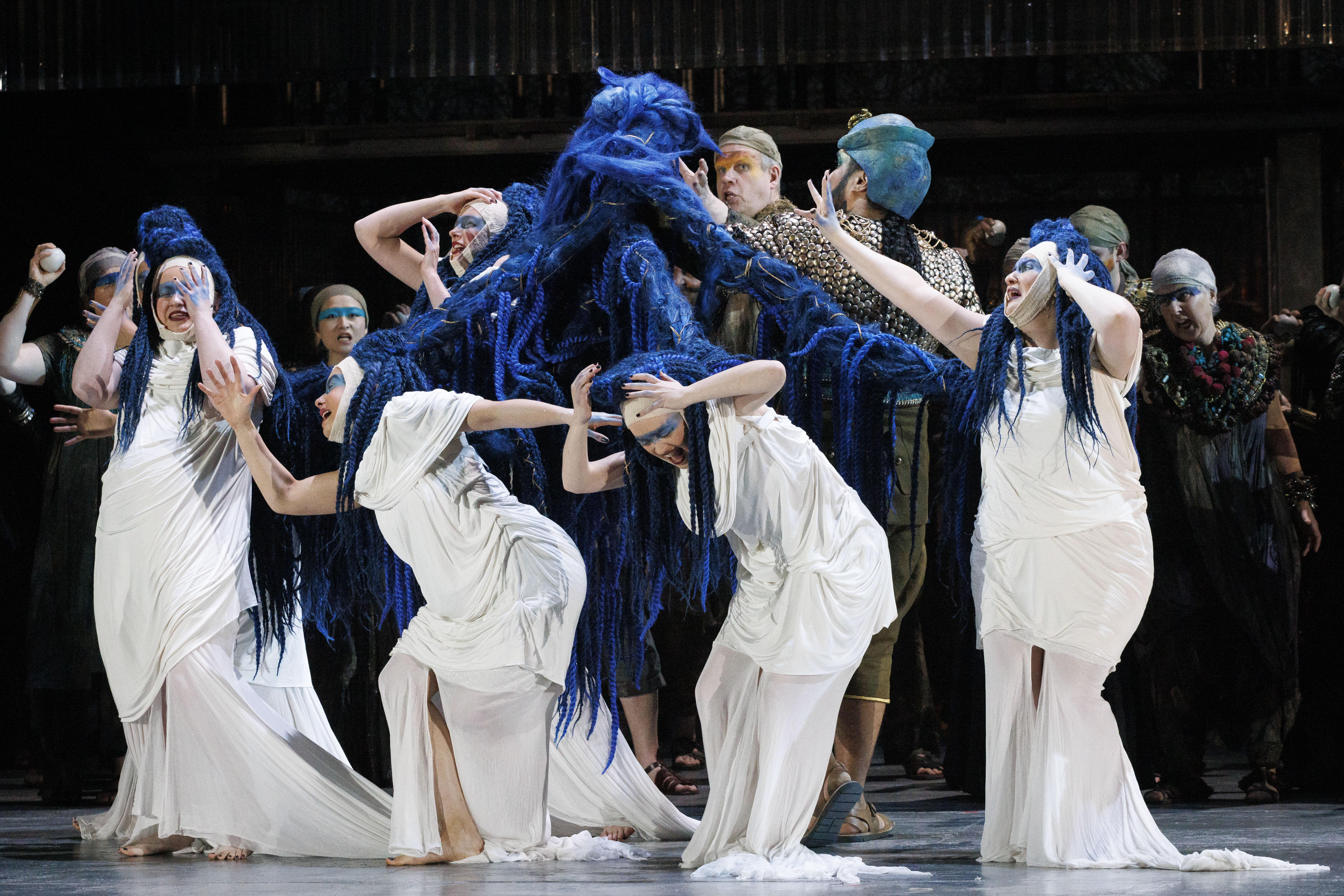
Little is known about the life of Pharaoh Akhenaten. Thus, although the opera aims to maintain a high level of historical accuracy, there are scenes that leave room for imagination. This is where Phelim McDermott, the renowned English actor and stage director, seizes the opportunity to turn this production of 'Akhnaten' into a spectacular visual show, featuring a large number of performers, jugglers, light displays, digital projections, and, as one would expect in an opera about Egypt, architecture worthy of a pharaoh.




Although Philip Glass’s extensive catalog (Baltimore, 1937) includes more than twenty works that can be considered operas, the truth is that the New York–based composer has always sought to maintain some distance from the genre. In fact, the first time Glass ventured into musical theater, he did so from the cutting edge of the avant-garde, taking an openly nontraditional stance. To understand the origin of Akhnaten, one must look back to the early 1970s. At that time, Glass was an emerging composer within the downtown New York scene —the environment where the minimalist language was being developed, not in auditoriums or concert halls, but in art galleries and private apartments. Philip Glass was then a composer with few works and even fewer listeners, yet he had a solid style —based on the hypnotic repetition and modulation of chords creating a frenzied sense of motion— and a growing network of contacts, including composer Steve Reich, with whom he would later feud, and the playwright Robert Wilson.
Over the years, Bob Wilson has become one of the leading stage directors of contemporary opera, but around 1972 he was, like Glass, a heterodox nonconformist seeking to shake the foundations of avant-garde theater. Together they began a project titled Einstein on the Beach, which, for lack of a better term, was classified as an opera: it consisted of a series of very static scenes, with no singing or action, but with profound intellectual depth, based on the life and scientific discoveries of Albert Einstein. After its premiere and the success it had in Avignon and New York in 1976, Glass went from being an amateur composer to becoming the new sensation of the popular avant-garde. Among the series of commissions he began to receive —mostly soundtracks and record releases— came requests for more operas in the vein of Einstein on the Beach. In 1980 he premiered Satyagraha —about the life of Mohandas Gandhi, sung in Sanskrit—, and in 1981 the Stuttgart Opera specifically requested a work that would become Akhnaten, which Glass conceived as the conclusion of a trilogy on great historical figures: if Einstein represented science and Gandhi embodied politics, Pharaoh Akhenaten allowed him to address religion.
“Akhnaten was Glass’s first opera with a storyline easy to follow, featuring sung parts in English, yet never abandoning his transgressive musical style.”
Of Glass’s first three operas, Akhnaten is the one with an operatic language closest to conventions, while still being an experience more akin to avant-garde theater than traditional opera. For example, there are spoken and sung parts in English, such as the protagonist’s aria in the second act —until then, Glass’s stage music had almost no text, or the text was expressed abstractly, as in Einstein on the Beach, or in a dead language, as in Satyagraha— as well as a love duet and a trio, plus an imposing presence of the chorus. And, most importantly, Akhnaten has a narrative. The opera follows the life of the pharaoh divided into several scenes, beginning with the funeral of his father, Amenhotep III, and continuing with his coronation, followed by the religious revolution he initiated: abandoning the Egyptian pantheon to worship the single god Aton —Aten in the operatic text— representing the solar disc. From there, the opera depicts the construction of the city of Aton, Akhenaten’s life in the new capital, the rebellion of the priests, and the complete erasure of his history, with a leap forward in time to the 20th century, allowing us to gain perspective on history and admire even more the power of the pharaoh’s transgressive message, which continues to resonate in our times nearly 3,500 years later.