


Between 1976 and 1980, Philip Glass premiered two musical theater works —'Einstein on the Beach' and 'Satyagraha'— that expanded the known boundaries of opera. Despite their repetitive language and high level of abstraction, these works captivated an audience eager for novelty and opened the door for Glass to create another opera, 'Akhnaten', with which he completed a trilogy on revolutionary historical figures. The work focuses on Akhenaten, a 14th-century BC pharaoh who introduced a monotheistic religious reform, and serves Glass as a way to explore the mystery of ancient Egypt.




In the mid-19th century, the discovery of a new archaeological excavation at Al-Amārna —a corner of the Nile a few kilometers northeast of the Valley of the Kings in Egypt— revealed the existence of a pharaoh previously unknown to historians. The mysterious monarch was named Akhenaten —he was the successor of Amenhotep III and the predecessor of the famous Tutankhamun— and had held power during the most prosperous period of the so-called Middle Kingdom, in the mid-14th century BC. This silence of nearly 35 centuries is explained because, after his violent death —the bureaucratic and religious authorities rebelled against him— it was ordered that no trace of his name remain. Akhenaten had done something unprecedented and provocative, a true heresy: he imposed a monotheistic vision of the Egyptian religion, declared that the old gods —Isis, Horus, Ra, etc.— be replaced by a single god, Aten, the representation of the solar disc, and ordered the construction of a city dedicated to this new cult.
Fortunately, not all traces of Akhenaten have been lost. Over the decades, inscriptions, letters, statuettes, and other stone-carved clues have been discovered, expanding the limited knowledge we have of the pharaoh’s life and deeds. This knowledge eventually became a great fascination for many people, especially during the second half of the 20th century —and particularly considering Akhenaten’s heterodox and pioneering nature, as he promoted a monotheistic vision a century before the historical Moses. Composer Philip Glass was also captivated by the mystery of Akhenaten and the so-called Amarna Period, which covers his 17-year reign. Thus, when he had the opportunity to begin creating a new opera around 1981, this was the theme he chose: a mysterious Egypt illuminated by the power of the sun.
“Premiered in 1984, Akhnaten is the majestic conclusion of the trilogy of minimalist operas composed by Philip Glass based on revolutionary historical figures.”
Glass was responsible for the music and the libretto. In creating the text —which consists of a collage of ancient and modern fragments that directly reference Akhenaten in various languages (Ancient Egyptian, Akkadian, Hebrew, and English)— he, however, relied on the help of specialists, mainly the Egyptologist Shalom Goldman, to give the opera greater rigor. The work is structured in a series of scenes depicting well-known moments of the pharaoh’s life and court, with a significant presence of Queen Nefertiti, his family, and his closest political circle. Even so, Akhnaten —the name of the opera is an artistic license by Glass, as the pharaoh has never appeared written in this phonetic form in any historical source— is not intended to be a documentary opera, but an immersion into the mystery of an extraordinary man who sought to carry out a revolutionary shift in thought for his time, blending reality and legend. Akhnaten thus stands halfway between rigor, well-founded speculation, and a touch of free fantasy.
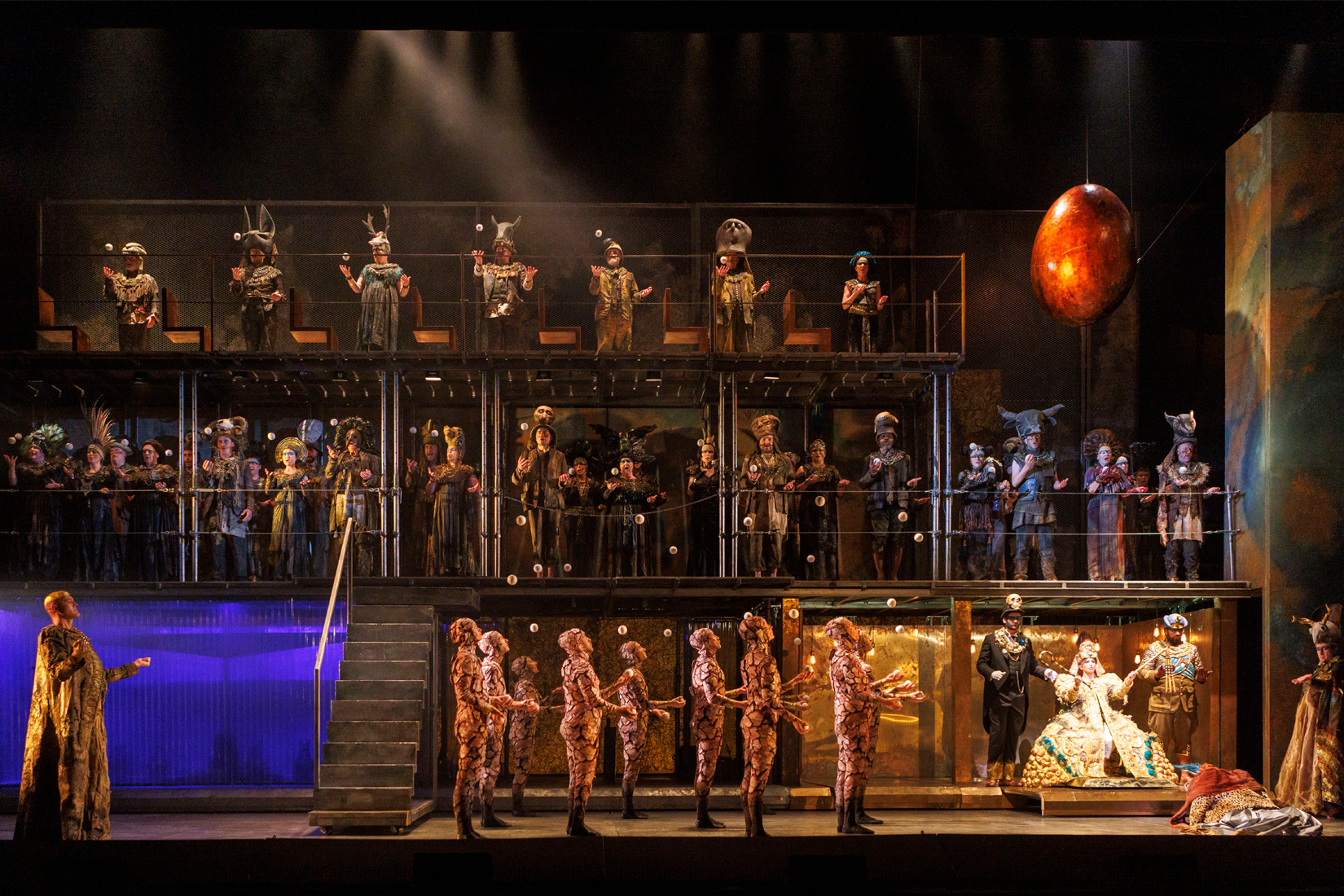
This is the concept that Phelim McDermott, the stage director of the production now coming to the Liceu, takes as his starting point to transform Akhnaten into a monumental spectacle. When he was commissioned to revive Glass’s third opera for the English National Opera and premiere it in 2016, McDermott chose to convey, in his own words, “a mythical and idealistic vision” of ancient Egypt. Using various stage strategies, such as luxurious costumes, detailed character design, stage arrangements on multiple levels —some scenes feature elevated spaces for the choir and performers— and technical resources like 3D mapping of images on the backdrop, Akhnaten becomes an exuberant fantasy full of symbolism and imagery evoking the time of the pharaohs.
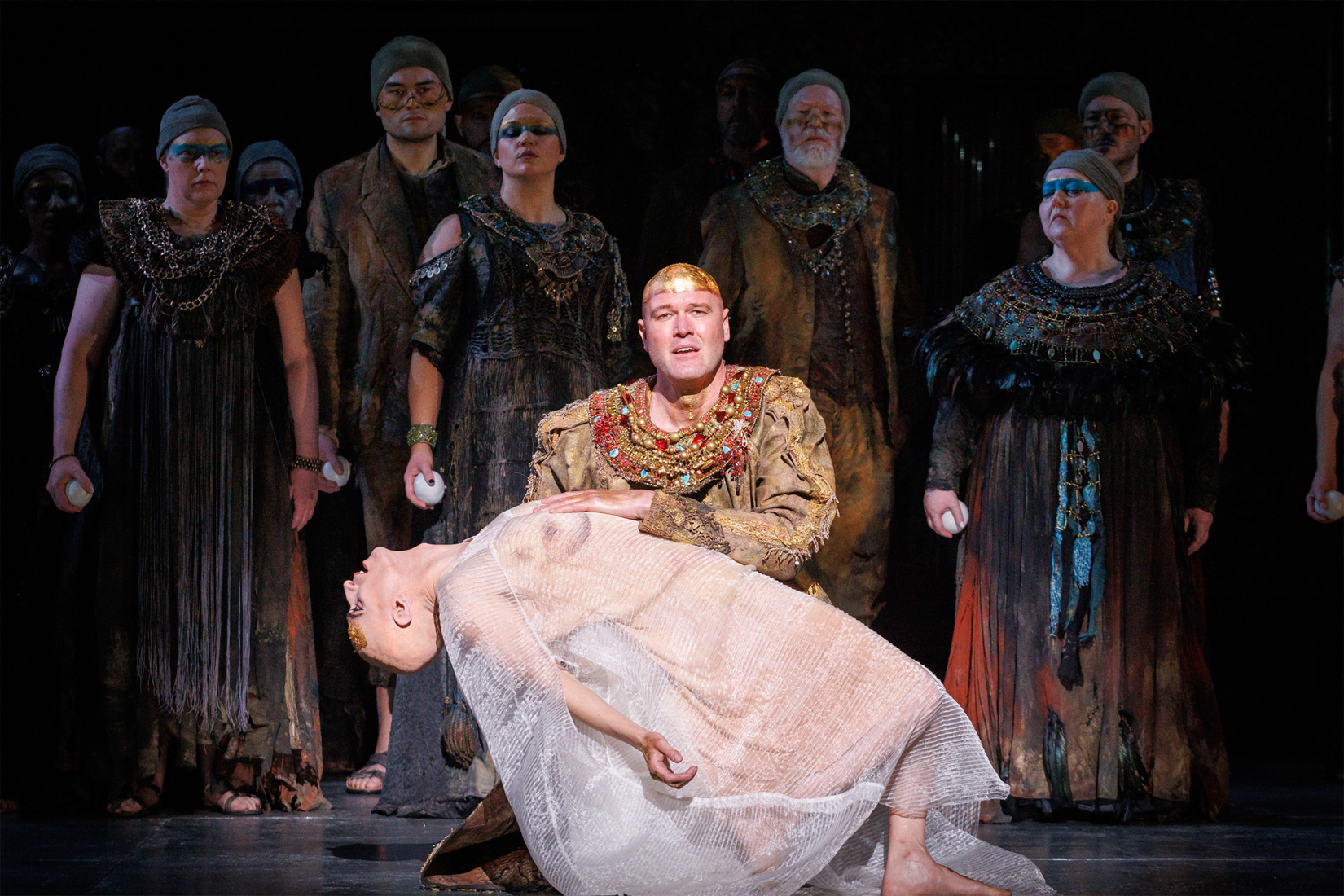
For example, some stage spaces are created based on architectural designs taken from preserved excavations, and hieroglyphs and figures from reliefs found in temples and tombs are projected onto the backdrop or stage set. At the same time, McDermott proposes costumes, makeup, and jewelry close to what is believed to have been worn in the period. Furthermore, to compensate for the limited action of the opera, he also fills the stage with elements such as fabrics, luminous backdrops, choreographies, and —a unique feature of this production— the presence of a group of performers specialized in juggling. This is possibly the most striking aspect of the production, and what has led to its prior success in Los Angeles and New York: the juggling accompanies the frenzied development of Glass’s minimalist music in an obsessive manner. In short, the Egypt of Akhnaten is not real, but it is a version that will keep us captivated in our seats with eyes wide open.
“After performances in London, Los Angeles, and New York, the Liceu premieres in Spain a key 20th-century opera, with a spectacular production by Phelim McDermott.”
This does not mean that this production of Akhnaten lacks concern for accuracy. Some scenes draw on information we have about the Middle Kingdom —family relationships, daily life, the mummification process of the kings— and transform specialized knowledge into a dramatic device. For example, in Egypt it was believed that if a deceased person’s heart was as light as a feather, the passage to the afterlife would be easy. In this sense, in the first scene —which recreates the funeral of Amenhotep III, Akhenaten’s father— we see the priests weighing the king’s heart and certifying that he had a good death. This is a clear example of what McDermott’s production offers: a dynamic contrast between fantasy and rigor, between spectacle and narrative function, coming together, like the heart and the feather, in perfect balance.