


Handel spent more time than usual on this piece to refine its qualities: rich orchestration, unforgettable melodies, and a dramatic depth rarely seen in Baroque opera. Calixto Bieito’s production focuses on the moral aspects of the story and, above all, on the dark side of desire and power.




Although Giulio Cesare is filled with historical figures —some very well known, such as the Roman general Julius Caesar and the Egyptian queen Cleopatra— this does not mean the work has a documentary intent. Eighteenth-century opera seria, of which this is a prime example, sought in past events and mythological tales a model for conduct, a moral guide to illustrate the virtues and flaws of human character. And even though the story is rooted in several key (and biased) Roman historiographical texts —Lucan’s Pharsalia and Julius Caesar’s Commentaries on the Civil War, among others— librettist Nicola Francesco Haym, who adapted a 1676 version by Giacomo Francesco Bussani for a previous opera composed by Antonio Sartorio, was less interested in reconstructing a plot than in reflecting on power. One verb recurs constantly in the libretto and is shared by several characters in the opera: to rule.
“Bieito does not approach this opera as a historical document, but rather as an exploration of human nature, especially regarding the toxic dimension of the obsession with power.”
The main characters are obsessed with gaining power at any cost: Giulio Cesare wants to reaffirm his victory over Pompey, which is why he grants pardon to his widow and son — thus extinguishing any desire for revenge against him, which they ultimately project onto King Tolomeo. Tolomeo, for his part, seeks to rule Egypt alone and therefore murders Pompey to please Cesare. Cleopatra, meanwhile, uses her unfailing powers of seduction to attract Cesare and wield his power against Tolomeo. In this way, different approaches to ruling are set against each other: through violence and cruelty, or through generosity and virtue.

Thus, Giulio Cesare is an extensive catalog of human passions and, just as Haym and Handel were not particularly interested in the events —but rather in the deeper motivations of the characters— director Calixto Bieito, from Burgos, is also not obsessed with the historical background, but with everything this opera can reveal about human nature. His proposal, a co-production between the Gran Teatre del Liceu and the Dutch National Opera, which was enthusiastically received at its premiere in Amsterdam in 2023, moves the story to a very generic present time, which is primarily perceived in the costumes —Giulio Cesare, Tolomeo, and their assistants, Curio and Achilla, dress elegantly, in suits and ties, as if they were members of a government or board of directors of a multinational— and in the neutrality of the set. Bieito proposes a functional and, to some extent, aseptic set design, with a flexible structure at the center of the stage that serves as a platform for characters to ascend, descend, or appear from behind. This is complemented by a dark background, intense lighting on the singers, and in the Parnassus episode —at the start of the second act— the lighting atmosphere becomes more dreamlike and warm, as it is the moment Cleopatra showcases her seductive powers.
“The minimalist set design leaves enough space to emphasize the dramaturgy, allowing the characters to be presented as archetypes of their moral conflicts.”
But what truly defines this production is the dramaturgy, the way Bieito characterizes each character according to their psychology, and how the tension between different desires drives the plot forward until the end, when Giulio Cesare triumphs thanks to his generosity and compassion, another path —less cruel, but equally effective— to defeat his enemies and achieve power, represented in the offering he makes to Cleopatra: a throne that, following Bieito’s memorable provocative and iconoclastic tradition, is a toilet. The story of Giulio Cesare is also filled with cruel moments or perverse cunning that give Bieito the opportunity to strike the audience by avoiding gratuitous scenic excesses and, thus, utilizing resources such as eroticism, disgust, or ridicule to complete the psychological portrait of the characters. For example, at the start of the first act, Tolomeo’s emissary, Achilla, presents Cesare with the head of his enemy, Pompey.
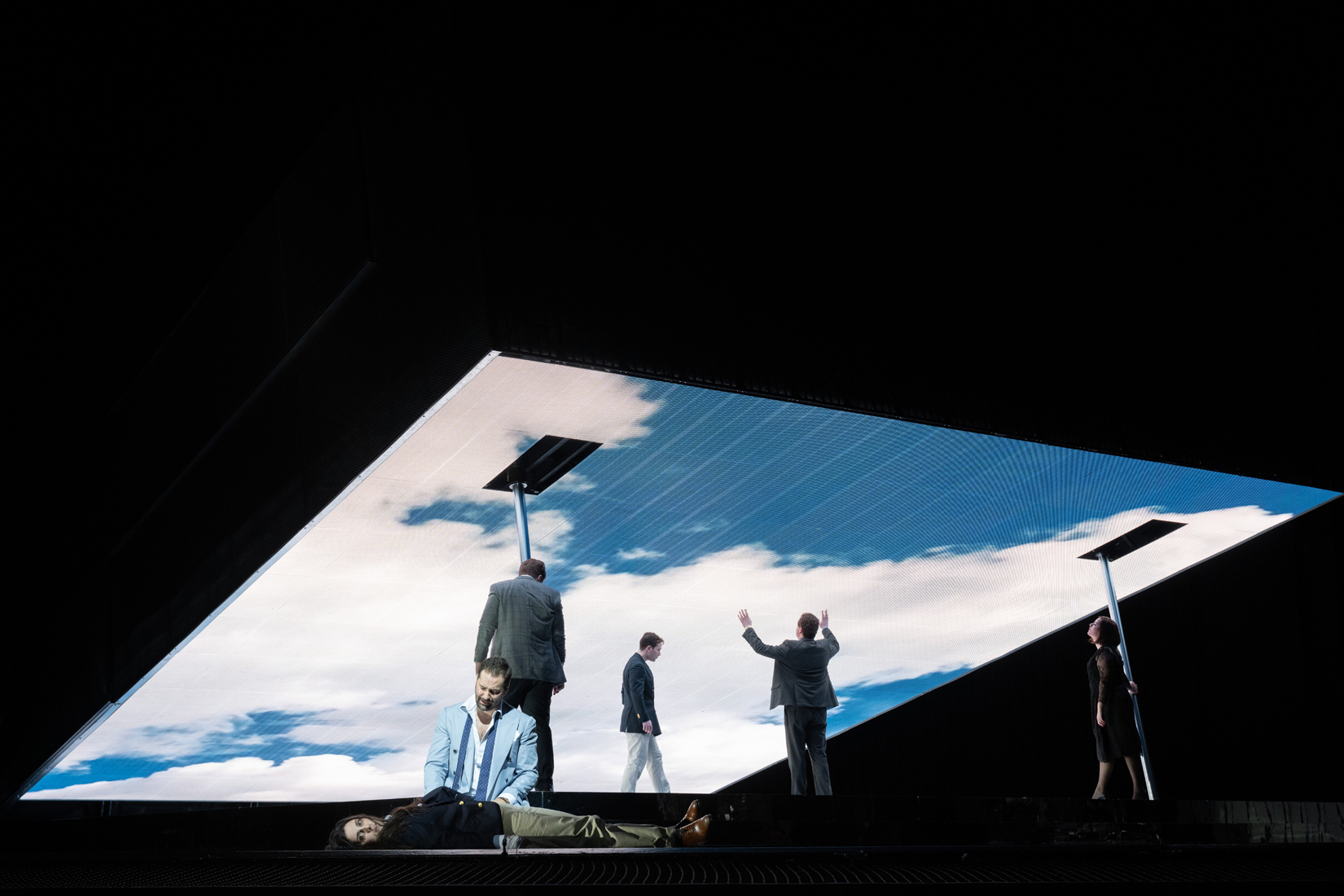
In the libretto, Cesare is horrified upon seeing the bloody remains of his rival. On stage, as expected, the head is shown so that the audience can share the character's disgust through a clearly explicit theatrical device. And yet another example: to gain Cesare's help, Cleopatra disguises herself as Lidia, one of the servants, in order to seduce him. She presents herself as an attractive young woman —very much of the 21st century, in sweatpants, a hoodie, and sneakers— hoping to arouse the libido of an impressionable man who quickly embarks on a shameless and rather crude courtship ritual.
“Faithful to the explicit nature of the libretto, Bieito takes advantage of different moments in the text to confront the audience with violence and the most primal sexual drive.”
Bieito, however, never tries to be gratuitous or vulgar. All these scenic nuances —in the glances, in the physical contact between characters, in the props that emphasize cruel aspects or primal impulses— subvert the initial thesis: Giulio Cesare is an opera about power and the moral positions that seek to conquer or maintain it, but it also ridicules those who are seduced by power, as, although the libretto suggests that in the end virtue triumphs over meanness, in reality, Cesare’s honorable behavior is false, not serving an absolute good, but a personal interest. Therefore, the morality is clear: power is always dishonest, no matter how much it is presented with good intentions.