


'Manon Lescaut', an opera by Puccini premiered in 1893, tells the passion and tragedy of a young woman caught between love and luxury. Àlex Ollé’s contemporary version at the Liceu presents Manon as an undocumented immigrant seeking safety, with Asmik Grigorian leading a cast that conveys intensity, vulnerability, and the urgency of a universal story of desire and downfall.




Manon Lescaut, an opera in four acts premiered in 1893 at the Teatro Regio di Torino, is based on Histoire du chevalier des Grieux et Manon Lescaut (1731) by Abbé Prévost, which also inspired the opera Manon by Jules Massenet. “Manon is a heroine I believe in and therefore cannot fail to win the audience’s heart. Why shouldn’t there be two operas about Manon? A woman like Manon can have more than one lover,” Puccini himself wrote to his publisher.
Manon Lescaut was his third opera and his first major success. It brought him lasting fame and marked the beginning of a fruitful collaboration with the librettists Luigi Illica and Giuseppe Giacosa, with whom he wrote three masterpieces: La Bohème (1896), Tosca (1900), and Madama Butterfly (1904).
When Manon meets the young student Des Grieux, they fall in love and run away together, but when the elderly Geronte offers Manon a life of wealth and luxury, she hesitates and follows that life of pleasures. Unable to forget Des Grieux, Manon tries to flee with him again, but before they can escape, Geronte has Manon arrested. Nevertheless, they manage to escape, unknowingly, toward hell. Manon collapses from exhaustion and dies in Des Grieux’s arms while telling him she loves him. All efforts have been in vain.
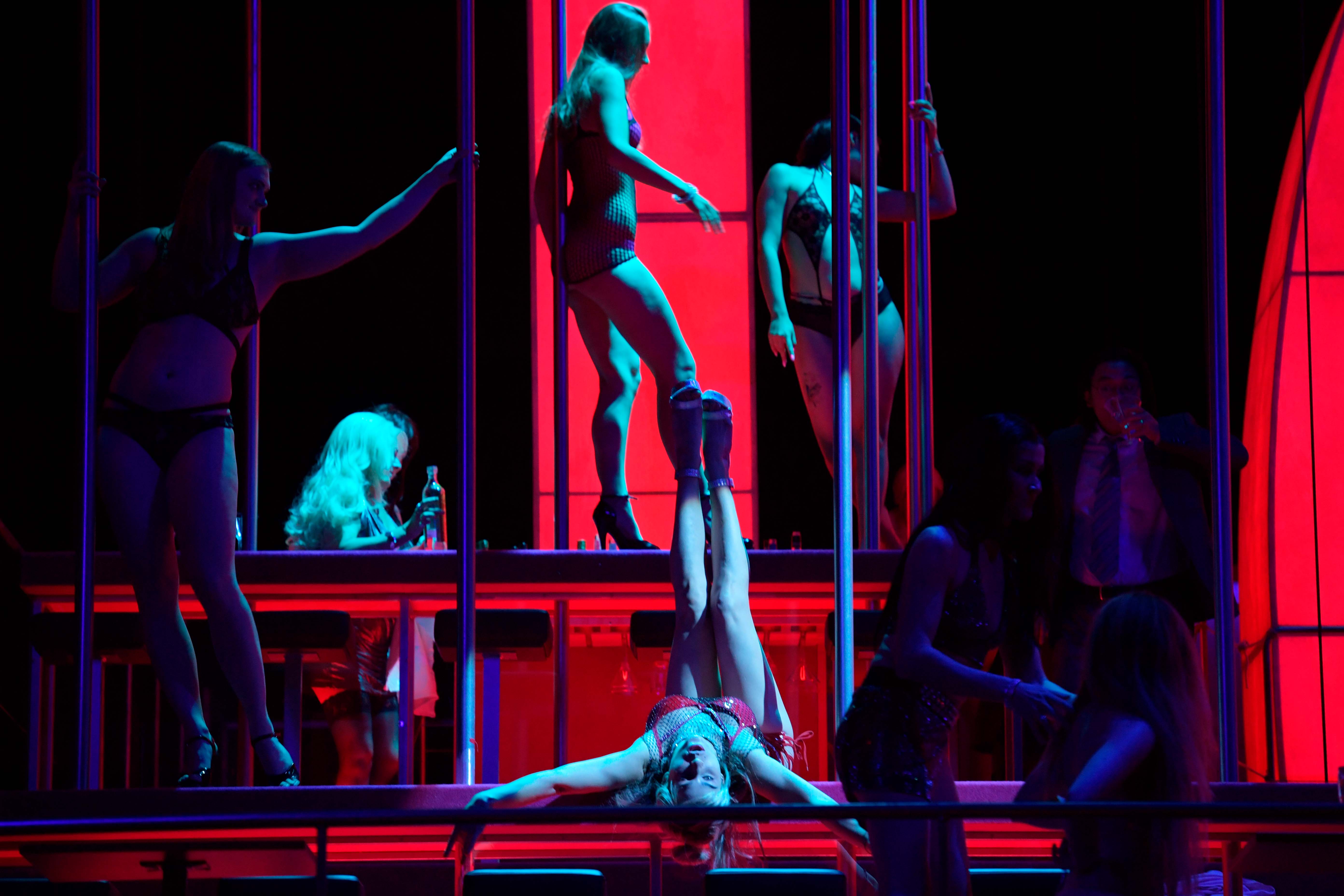
Àlex Ollé’s staging originates from the Frankfurt Opera. In the introductory sequence, videos explain that Manon and her brother Lescaut cross a border fence and enter as undocumented immigrants. The harassment she suffers because of her beauty and physical appeal leads to abuse and exploitation. With urban costumes by Lluc Castells and set design by Alfons Flores, Ollé guides these characters—inflamed by love and torn between virtue and pleasure—through a bus station, a pole dance club in which Manon is the star, and claustrophobic cells as a prelude to deportation. The constant presence of giant letters spelling the word love serves as a reminder of this unpredictable passion as the opera’s guiding thread.
Asmik Grigorian, one of today’s leading sopranos, stars in the production, delivering a powerful vocal and dramatic performance. Innocent and vulnerable, the Manon envisioned by Ollé for Grigorian expresses herself—together with American tenor Joshua Guerrero—with intensity, frivolity, and steadfast passion.
The urgency of Manon Lescaut today lies in its power as a metaphor for a world that promises immediate happiness in exchange for the gradual loss of freedom. Puccini portrays a society in which desire—economic, social, emotional—accelerates decisions until they become irreversible, and in which love is caught between luxury as a mirage and precariousness as destiny. Manon does not fall because of frivolity, but because of the pressure of a system that turns the body, affection, and the future into commodities. In this sense, her tragedy speaks with contemporary urgency: that of a humanity seduced by the instant, driven to consume itself before learning how to love without fear.
From another perspective, related to social media, Manon Lescaut emerges as a sharp allegory of the contemporary cult of appearances. Puccini anticipates a world in which desire no longer arises from experience, but from the gaze of others: Manon quickly learns that to exist is to be seen, and that personal value is measured in jewels, privileges, luxuries, and displayable promises. As on digital platforms, love becomes scenography, luxury becomes identity, and happiness becomes an edited narrative. The core of the work revolves around this drift: when life is lived as a permanent shop window, the fall is not an accident, but the only possible ending of a system that confuses visibility with truth.