

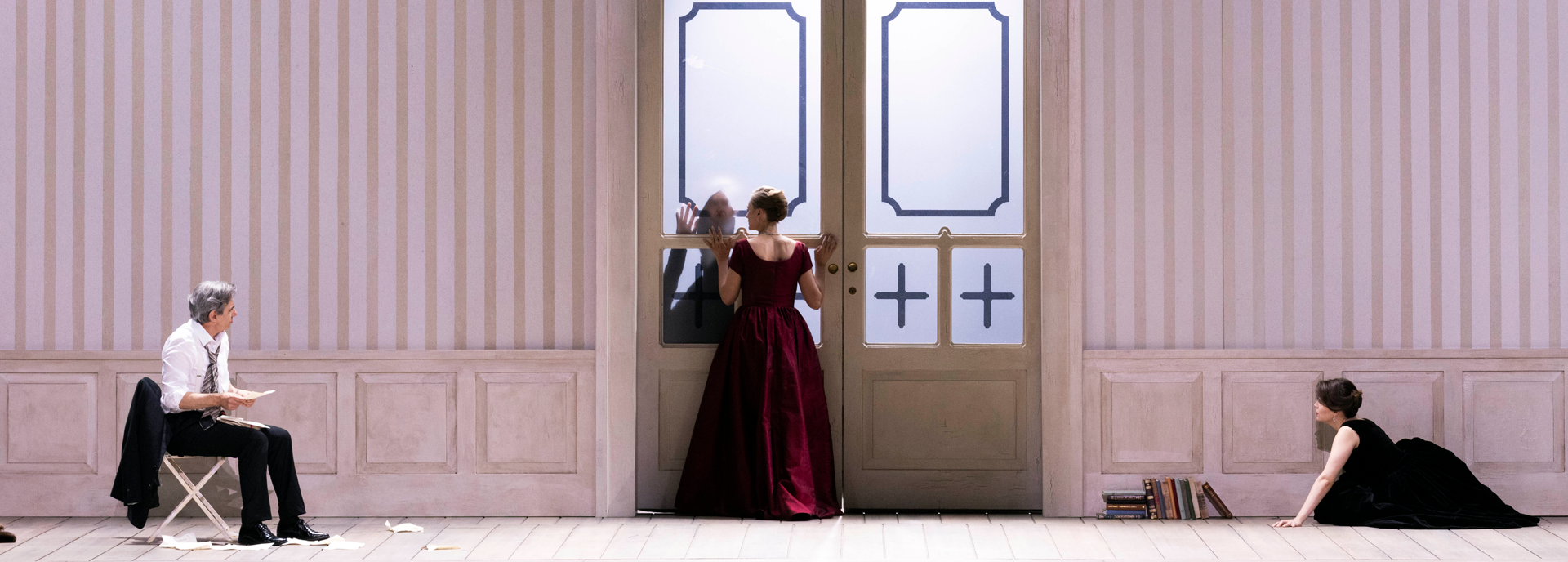
The opera 'Werther' by Jules Massenet, based on the novel by Johann Wolfgang von Goethe, depicts an impossible love marked by passion and despair. At the Liceu, the production delves into the characters’ psychology and features Xabier Anduaga’s debut in the leading role.




- Composer
- Jules Massenet
- Language
- French
- Duration
- 2h 40min
- Subtitles
- Catalan, Spanish, and English
- Acts
- 4
- Cast
- Xabier Anduaga, Matthew Polenzani, Kristina Stanek, Elmina Hasan, David Oller, Carlos Daza, Sofia Esparza, Leonor Bonilla
Since its publication in 1774, Johann Wolfgang von Goethe’s first novel, Die Leiden des jungen Werthers (in Catalan, Les tribulacions del jove Werther), became a resounding success in Enlightenment Europe because it imagined a new spirit for a time on the verge of change. Werther anticipated Romanticism: its central ideas were the desire for a simple life, admiration for nature, and the exaltation of passions, in contrast to faith in knowledge and rationalism. Werther is an idealistic young man, sensitive to beautiful things —gardens, poetry, youth— who makes a fatal decision: if he cannot win the love of Charlotte, the woman he adores, his life has no meaning; therefore, he chooses to die by a gunshot rather than endure a long life of unhappiness. For several decades, the pages of Werther served as a handbook for the first generations of Romanticism. Many young people took him as a model: they dressed like the character, prioritized passions over duties, and even some —around forty known cases— committed suicide in the same way as the character. A story like this, therefore, was destined to become an opera, the art that exalts all passions.
Portrait of the passionate young man
Jules Massenet tackled his version of Werther more than a century after Goethe’s book was published, at the end of the 1880s, and finally premiered it in Vienna in 1892. The success he achieved, in a way, closed the remarkable cycle of Romanticism with a sad and sentimental opera, which reaches its best moments when the characters are on the brink of despair, because harsh reality sabotages their deepest emotions, their need to love intensely and absolutely. The origin of Werther can be traced back to 1886: that year, shortly after the great success he had achieved with Manon two years earlier, Massenet attended the Bayreuth Festival with his publisher, Georges Hartmann, who gave him a French translation of Werther to read during the journey. There, he immersed himself in Wagner’s music and the Romantic spirit and decided to bring the story to the opera stage. He did so with an orchestral language denser than he had used up to that point, adding weight and drama to the work.
“The story deals with the unrequited love between the idealistic Werther and the responsible young Charlotte, which ends with the protagonist’s inevitable suicide.”
Massenet’s version is not exactly faithful to Goethe’s story, which is an epistolary novel and, in fact, quite difficult to adapt accurately. But it does capture the basic plot: Werther is a young man fond of poetry who arrives in a small German town, Wetzlar, and comes into contact with the mayor’s family. He has several young children and two older daughters, orphaned of their mother: Charlotte and Sophie. At that time, Charlotte is alone, as her fiancé, Albert, left six months ago on a business trip and has not yet returned. One day she invites Werther to a ball to accompany her. In the opera, Werther and Charlotte have not yet met, and in a beautiful scene, he falls in love with her at first sight. Upon returning from the ball, he confesses his love, but Charlotte must reject him: she is engaged to Albert and, moreover, swore to her late mother that she would marry him. At that moment, Werther feels his heart break: Charlotte is out of his reach, and without her, he does not want to live.
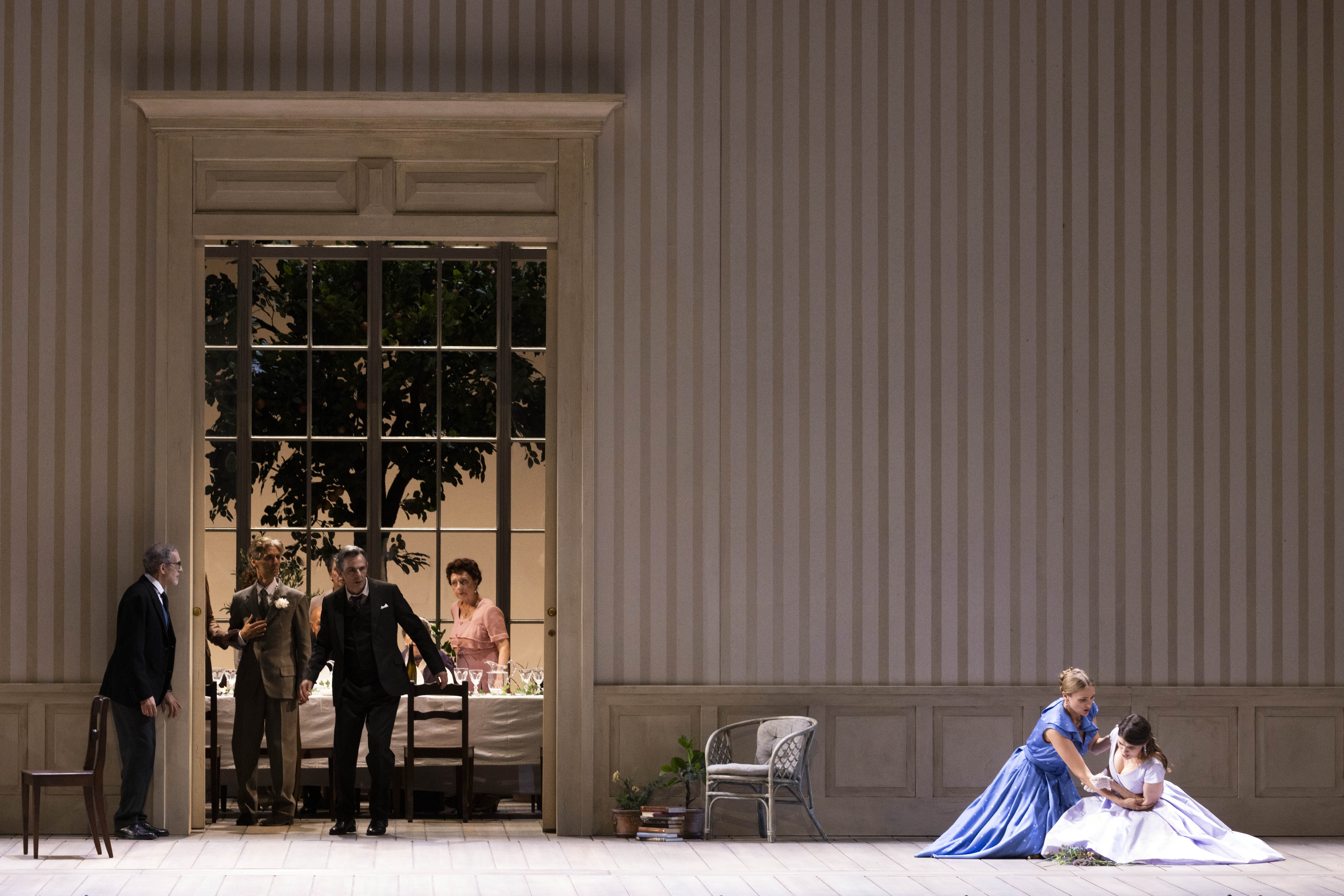
The development of the opera unfolds through further encounters between Werther and Charlotte, which only deepen the young man’s despair. In the third act, they meet for the last time at Christmas: she reminds him of his passion for poetry, gives him some Ossian verses he had translated, and Werther completely collapses. At this moment in the opera, he sings his most moving aria: “Pourquoi me réveiller?”. Determined to die, he steals Albert’s pistols and returns home. There, he shoots himself, and as he lies dying, Charlotte comes to him. In the final scene, she confesses that she loves him, but it is already too late.
Xabier Anduaga’s world debut in the role of Werther
The role of Werther is one of the most important and demanding in the lyric tenor repertoire, and in the Liceu performances we will have a top-level performer: Xabier Anduaga from Donostia, who will face a highly stimulating challenge. Anduaga will make his debut in the role in Barcelona —that is, he will sing it in full for the first time— allowing us to witness his impressive development and one of the milestones that will mark his career going forward. The same role will also be performed by American tenor Matthew Polenzani. The other important character, Charlotte, written for mezzo-soprano, will be performed by Kristina Stanek and Elmina Hasan, and Albert, Charlotte’s fiancé, will be sung by baritones David Oller and Carlos Daza. The Liceu audience will also be able to hear the great Barcelonan bass Stefano Palatchi, who will take on the role of the mayor, as well as sopranos Sofia Esparza and Leonor Bonilla in the role of Sophie. The musical direction will be led by Maestro Henrik Nánási.
“Tenor Xabier Anduaga faces one of the most thrilling and demanding challenges of his career: he has chosen the Liceu to make his full debut in the leading role.”
Werther is, without a doubt, one of Massenet’s most complete and memorable operas, a composer who created over 25 works and boasts several classics in his repertoire. Massenet never ceased to be a Romantic, drawing themes from great works of world literature —Don Quixote, El Cid, Manon Lescaut— but with Werther he reached the peak of his maturity, not only because of the richness and variety of orchestral colors, but also for the balance of the drama. While the opera contains individual moments of great beauty, such as Werther’s two arias and Charlotte’s aria in the third act, culminating in the moving final scene, what matters most in this opera is the whole. It has a perfectly circular structure; the entirety of the drama shines above its individual parts —which are, colloquially speaking, the cherry on top— and, above all, it captures the essence of Werther’s personality, his desperate longing for an impossible happiness because he cannot put common sense above his innermost impulses. Despite everything, it is impossible not to feel compassion for this character, because everyone has felt and loved with the same desperate intensity as Werther.
A psychological exploration of the tormented soul
The production we present in these performances is directed by the German Christof Loy, a regular stage director at the Liceu in recent seasons (Eugene Onegin, Rusalka) who is always known for exploring the deeper questions of the story. While he consistently delivers beautiful, functional, and intelligent sets, Loy does not aim to stay on the surface of the stories; he seeks to delve into the psychology of the characters, treating them as complex human beings and understanding their motivations. This staging takes place in a single space divided into two levels of depth, which serves to depict Charlotte’s house, Wetzlar’s public square, and Werther’s home. But this space has a symbolic dimension: the further back the action occurs, the closer it is to reality; the closer to the front of the stage, the more it belongs to Werther’s world of emotions and desires. The costumes, designed by Robby Duiveman, are very faithful to the character: Goethe noted that he wore a yellow waistcoat, and our Werther will be dressed accordingly. Lighting, designed by Roland Edrich, is also crucial, subtly emphasizing the mood and tension of each scene.
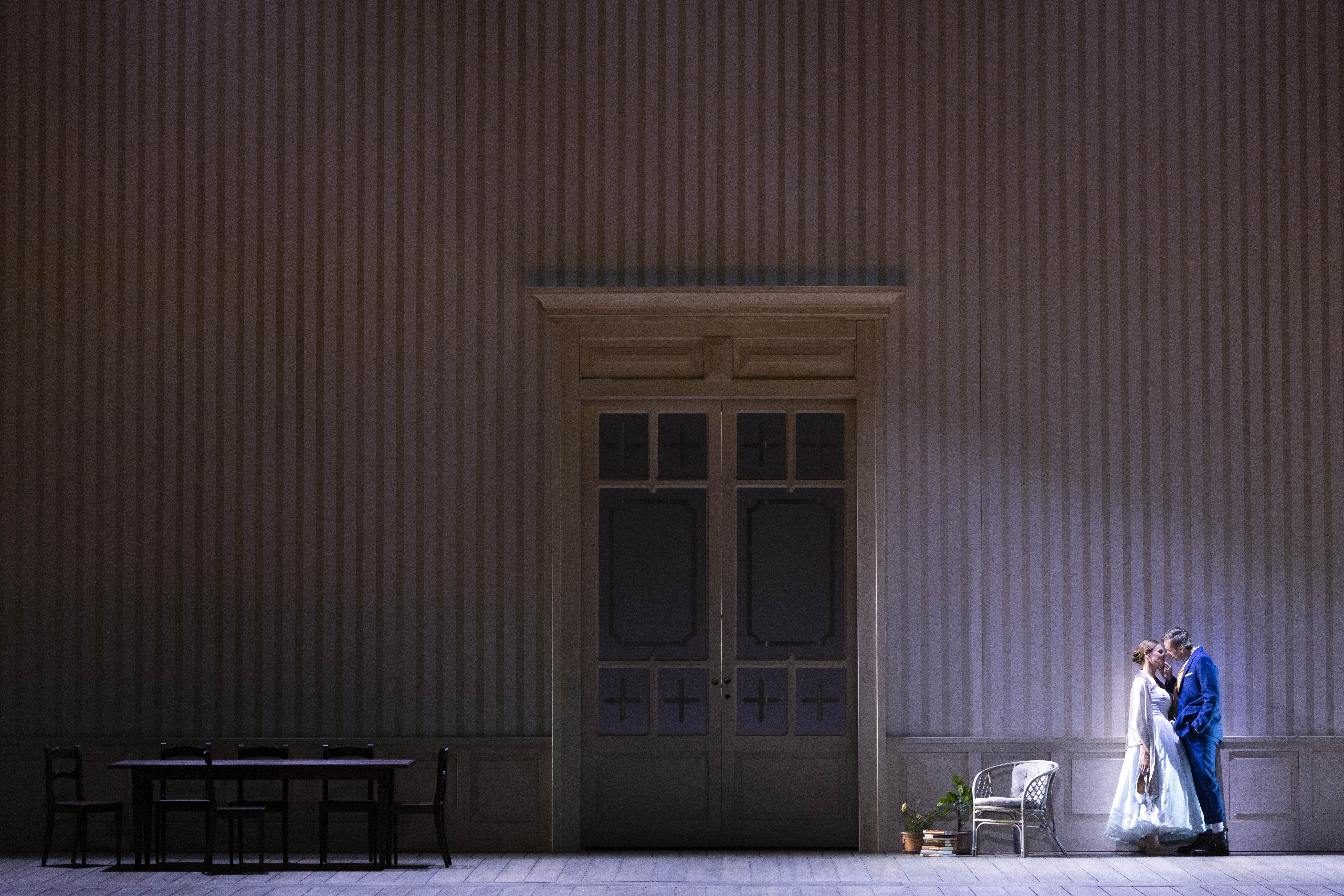
Throughout history, Werther has been adapted into other forms: it has been widely recreated in later literature, there are film versions, and of course, since the late 18th century, the first operas began to appear. However, today only Massenet’s version has endured—the one most faithful to the spirit of the character, deeply human, musically superb, moving even in the smallest details, a true Romantic apotheosis.
Key musical moments
Act III, Charlotte
«Je vous écris de ma petite chambre»
Charlotte is at her desk, going over letters sent to her by Werther. As she remembers him, she becomes emotional and sings her aria, expressing conflicting feelings: the affection she feels for the young man, but also the duty to stay away for the sake of her marriage. The orchestra accompanies the singing, which leans toward the lower register, with a trembling harmony reflecting the pain that overwhelms the character, but also a brighter moment, a brief instance of optimism… before she realizes that her happiness is impossible, neither with Werther nor without him.
Act III, Werther
«Pourquoi me réveiller ?»
Charlotte reminds Werther of his love for the poet Ossian and shows him some verses he had translated long ago. At that moment, Werther collapses: he realizes that if he does not have Charlotte’s love, nothing—not even poetry—can save him. The aria is brief and concise, yet of admirable formal perfection: in just a few lines of maximum intensity, Werther’s inner portrait is complete—a highly sensitive man who, faced with the impossibility of achieving his ideal, ultimately rejects life and the beauty of nature. After this scene, he will finally decide to leave Charlotte and return home, where he will take his own life with a gunshot.