


Inspired by the novel by Johann Wolfgang von Goethe, Jules Massenet’s 'Werther' tells the story of an obsessive and impossible love that leads to tragedy. A striking opera about emotional intensity, social pressure, and mental fragility.




In 1774, The Sorrows of Young Werther was published, a novel with autobiographical traits by the then-unknown German writer Johann Wolfgang von Goethe, aged 25. It quickly became a milestone of world literature. The work belongs to the Romantic period and is one of the best examples of the Sturm und Drang movement; an epistolary novel that tells the story of Werther, a passionate young man who writes letters to his friend Wilhelm about his obsessive love for Charlotte, who rejects him to marry another man, because she promised her dying mother.
Paradoxically, the novel’s success became a major social problem, as in January 1775 a wave of love-inspired suicides began, modeled on the Romantic hero. These cases continued for several years and became a phenomenon later widely studied and spread throughout Europe. Fascinated by the intensity of the plot, Jules Massenet began setting it to music in 1885.
Premiered in German at the Wiener Staatsoper in February 1892, it enjoyed moderate success. It was not until performances in Geneva and Paris in the French version that it established itself as one of the composer’s finest works.
The role of Werther, due to its vocal difficulty, is often called the “French Tristan,” and Charlotte is given some of the most intense and dramatic pages in the entire repertoire. Xabier Anduaga (in his debut in the role) and Matthew Polenzani will alternate with the Charlottes of Kristina Stanek and Elmina Hasan. Extraordinary voices will immerse us in this score, which is nothing more than an intimate confession of contained feelings, inner expressions conveyed through a strikingly delicate melodic line, and an elegant orchestral framework.
This new production, from Teatro alla Scala in Milan and directed by Christof Loy, focuses on the interpersonal mechanisms and psychological aspects of the characters. With an intimate approach to the protagonists, it places them in an elegant and essential set design set in the 1950s, dominated by a large horizontal wall that encloses the central roles’ action and suffocates them in their deepest emotions. This wall separates the world of domestic intimacy, affections, and feelings (the family world, which Werther can never enter) from the outside world. The sparseness of the space gives the elements an additional, highly suggestive symbolic charge.
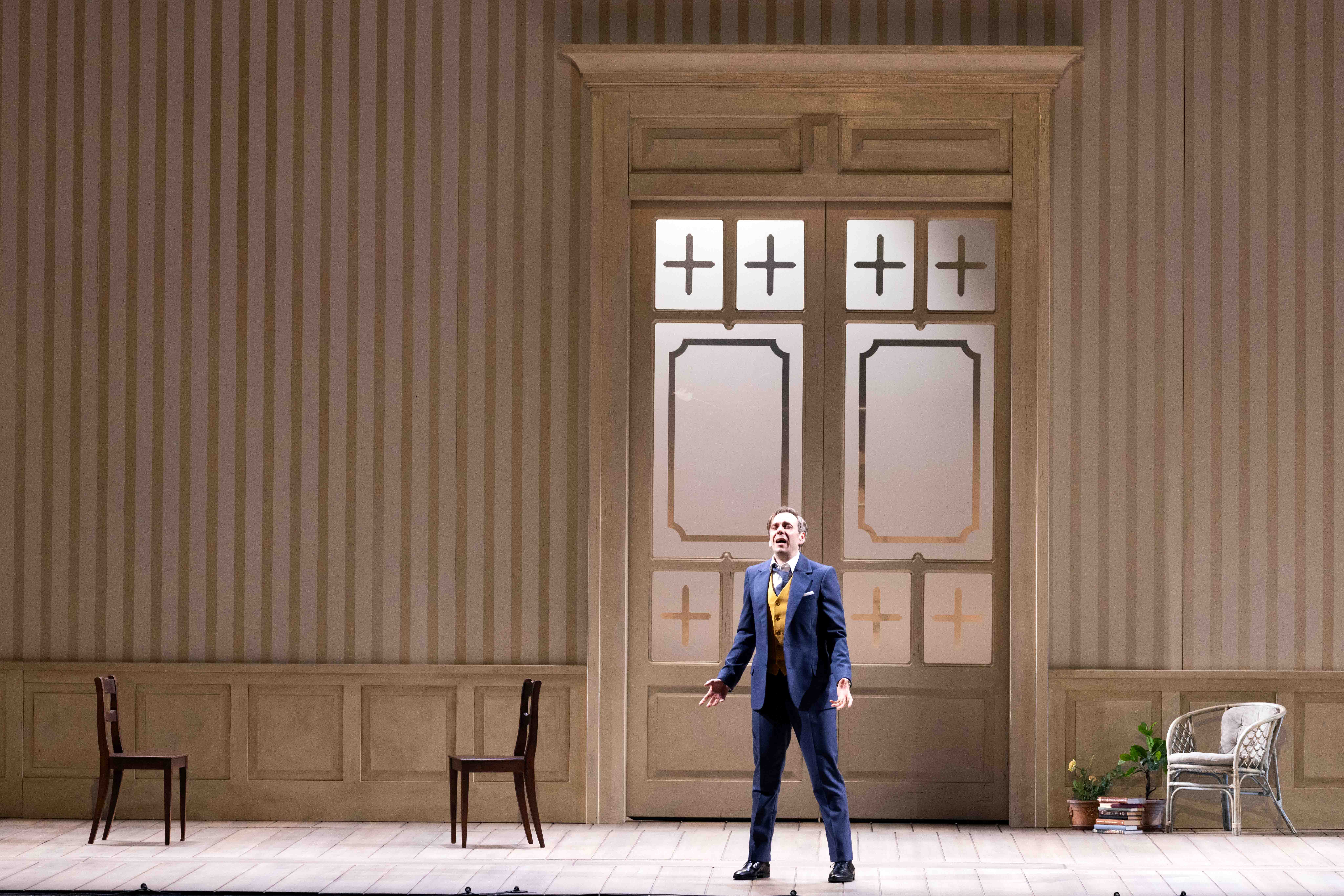
Conformity and the norm of convention will be an impossible prison to overcome and will mark his fate in facing personal tragedy and death as the only way out. Charlotte arrives too late: Werther is already dying while she declares her desperate love. Outside, children sing of the birth of Jesus; a striking contrast that sends shivers down the spine.
Werther must be read today as an intense metaphor for emotional fragility and the weight of mental illness in a world that does not always understand or support it. Massenet captures with delicate precision the inner abyss of a young man who loves with overflowing and simultaneously destructive passion, showing how the exaltation of feelings can lead to despair and isolation. In a contemporary context, Werther resonates with the urgency of dialogue about mental health: misunderstanding, social pressure, and the idealization of love can act as catalysts for deep sadness and emotional overflow. His tragedy is thus a poetic and painful call to recognize, listen to, and support the most vulnerable emotions before it is too late.
“Dearest, I am sure that, again, I am going mad. I think I cannot survive another of those dreadful periods. I shall not recover this time. I have begun to hear voices and cannot concentrate. Therefore, I am doing what seems best. (...) I cannot fight any longer. (...) I cannot go on ruining your life any longer.” – Virginia Woolf, letter to her husband Leonard, moments before intentionally drowning herself in the River Ouse, 28.3.1941
Víctor Garcia de Gomar
Artistic Director of the Gran Teatre del Liceu